
Art in Daily Ritual | Sho Shibuya 澁谷翔
The Art of Permanence and Change
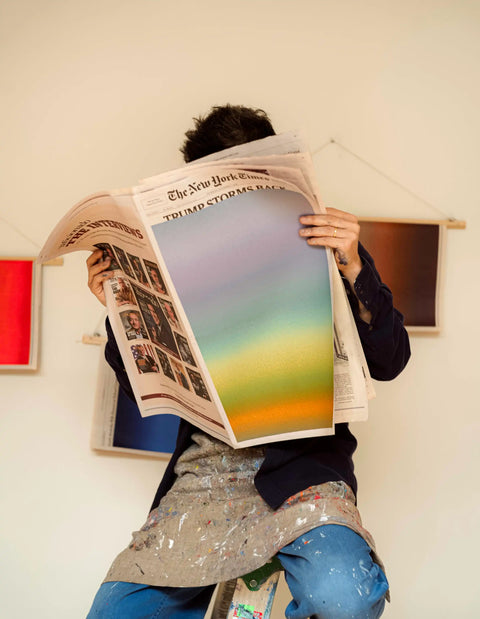
Sho Shibuya, a Brooklyn-based artist, begins each day by photographing the morning sky, going for a run, buying a copy of “The New York Times” from a newsstand, and painting the sky he saw that morning on its front page. Rain or shine, this has become his daily ritual.
His “Sunrise from a Small Window” series, which began in 2020 during the pandemic in New York after being struck by the beauty of the sunrise seen from his home window, has now continued for over five years.

“Sunrise from a Small Window” series
Born in Fukuoka and raised in Chiba, Sho studied architecture in school, where he discovered his interest in graphic design.
After graduation, he worked as an editorial designer for magazines. Seeking new horizons, he moved to New York in 2011, beginning as an intern before being appointed Art Director at the suitcase brand “AWAY” in 2016.
In 2018, he founded his own agency, “Placeholder.”
In 2019, he published “Plastic Paper”, a project focusing on the use of plastic bags in New York stores, followed by the launch of the sustainable “BAMBOO BIODEGRADABLE BAG”
In May 2020, he began his “Sunrise from a Small Window” series, painting skies on the front page of NYT, which quickly drew widespread attention. He later collaborated with musician Patti Smith on an artwork inspired by the series. The NYT featured “Sunrise” in an article on March 14, 2021.
In 2022, the series was exhibited at the Triennale Milano and later featured in a solo exhibition in collaboration with Saint Laurent at “Art Basel Miami Beach”. In 2025, exhibitions of his work are scheduled to be held at galleries in London and New York.
 Triennale Milano
In 2024, at the “Cartier and Japan: MUSUBI” exhibition held at the Tokyo National Museum, he presented the series “Nihon Gojuu Kuukei” (Fifty Skies of Japan), a collection of 50 paintings created during a 35-day journey across Japan.
His works are exhibiting at the PODO Museum in South Korea and the DIB Museum in Bangkok, Thailand until summer in 2026.

“Nihon Gojuu Kuukei” at Tokyo National Museum
IROHA: Could you tell us about your current or recent projects.
SHO: From December 2025 through 2026, my work will be exhibited at the DIB Museum in Bangkok, Thailand. A key highlight is that the work will also be displayed on the massive 80m x 20m billboard in front of the museum.
The Sunrise series began during COVID, when the world suddenly changed. At that time, the only hope I had was the sunrise I could see from my window each morning.
I went through a lot of trial in the early stages, figuring out the right size to paint.
Then, on May 24th, news broke that COVID deaths in the US had surpassed 100,000. The New York Times dedicated its entire front page to listing the names of those who died. I realized that partially obscuring those names felt like denying their existence.
I wanted to paint hope but partially hiding it would make it something else. So, I decided to fill it all in, and that's how I settled on this format.
For me, creating these pieces became a form of daily meditation—a process of seeking hope.

“Sunrise from a Small Window” series
Since moving to my current studio, I've been experimenting in various ways. For instance, I collect the cut-off pieces from the series and incorporate them into other works. Or I punch holes in newspapers showing the number of people killed by gunfire, then gather only that series of bullet-marked papers and hang them from the ceiling.
I also create works where I paint impressions from the morning news onto that day's paper. For instance, floods in Southeast Asia, forest fires in Los Angeles, the assassination of Prime Minister Abe, the Pope's death, or the Hong Kong building fire—whatever events are happening at the time.

”Events"series, December5 2025, Frank Gehry died at 96.
Although the Sunrise series has been ongoing for over five years, it’s not so much an object as it is an experience. Consistency—creating every day—is what gives the work authenticity.
The newspaper format remains constant, but the morning light and the news are always changing. Combining these unchanging and ever-changing elements is what makes it art for me.
Nothing changes in a single day, but through accumulation, change becomes visible. This cannot be achieved without time, and the longer time passes, the more value it gains.
I intend to continue this series until I can no longer create it, or until The New York Times stops publishing a physical newspaper.This daily persistence might be my only talent.
IROHA: So, you keep painting every single day, even while traveling?
SHO: Yes, that's right. Each time, I pack a large suitcase filled with nearly 30 kilograms of paint alone, but I must do it for the artwork to be complete.

55 Sunrises x Saint Laurent Solo Exhibition at Art Basel in Miami Beach
IROHA: When was the turning point that led you to start your artist career?
SHO: It started when I met the founder of AWAY right after the company launched. I was involved as an art director then. They had a personalization campaign where customers could add their initials to their suitcases, and right behind my desk, a lettering artist was hand-painting those initials.
Watching that, I thought, “This looks fun.” I bought the same materials and started painting myself. At first, I didn’t know what to paint, so I experimented with katakana lettering. I kept practicing little by little every day after work.
Working late into the night was the norm in Tokyo. but after moving to New York, I experienced leaving work on time for the first time. That unexpectedly freed up a lot of time, so I started creating art to fill it. Now I focus entirely on art, if I’d stayed in Japan’s work culture, I probably never would have become an artist.

2019, Plastic Paper
IROHA: Have you ever felt the “glass ceiling” problem as an Asian person trying to reach the top?
SHO: Personally, no. I’ve always felt grateful to those Japanese designers and artists who came before me and earned great respect—it made things easier for people like me.
When I first arrived in New York, I couldn’t speak English at all. But my boss, who sponsored my visa, even hired an English tutor for me to study before work every morning. I’ll never forget that generosity.

"Events" series,October 5 2025, Sanae Takaichi was elected Japan's first female prime minister
IROHA: What advice or message would you share with young people following in your footsteps?
SHO: Before overthinking, just try. If you’re in other countries and considering moving to the U.S., there are a thousand reasons not to—visas, legal issues, costs. You can always find excuses. But if you have an idea that truly excites you, go for it.
Once you start, problems will inevitably arise, but once you start, you can’t turn back—you’ll figure it out as you go.
People used to say, “Knowledge is power,” right? But for me, it's “Ignorance is power.” Too much information can make you overly cautious—wise enough to hesitate, constantly predicting risks instead of acting.
Sometimes, not knowing everything is what allows you to move forward.Trust your instincts. See it with your own eyes. Give it a shot.
IROHA: Outside of work, what interests you most right now?
SHO: I’d say studying philosophy. Politics changes too much year by year to really relay on.

“BAMBOO BIODEGRADABLE BAG”
written by Eri Kurobe, Photography: Courtesy to Sho Shibuya