
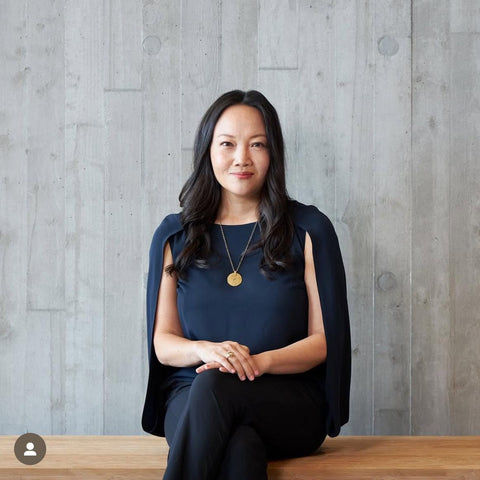
Curating Beyond Visibility | Mika Yoshitake 吉竹美香
Bringing depth, context, and fresh perspectives to Japanese art.
What does it take to bring overlooked art histories to the global stage?
Independent curator Mika Yoshitake has spent her career broadening the way Japanese postwar and contemporary art is understood and presented internationally. From landmark exhibitions of Yayoi Kusama and Yoshitomo Nara to lesser-known movements that deserve closer attention, her work brings new perspectives to familiar narratives.
In conversation with IROHA, she reflects on art, identity, and the practice of curating across cultures.
 with Yayoi Kusama
IROHA: Could you tell us about your current projects?
MIKA: I’m working on a number of projects as an independent curator. One of the most significant is a major thematic survey of Yoshitomo Nara at the San Francisco Museum of Modern Art (SFMOMA), scheduled to open in October 2027.
I’m also developing an exhibition for The Broad in Los Angeles in connection with the next Getty PST initiative, which explores the artistic and cultural exchanges between Los Angeles and the Pacific Rim and is planned for 2030.
I’m also serving as a curatorial advisor to Mitsubishi on a major residential development in Tokyo, across from the Imperial Palace, slated for 2030. I’m helping select works by approximately 60 artists, including newly commissioned sculptures.

with Yoshitomo Nara
Closer to home, I am about to open an exhibition titled Desert Migrations at Tamarisk Country Club in Rancho Mirage, on view through September 2027. The show explores the history of the Coachella Valley through the themes of land, migration, cultivation, and craft traditions. It brings together artists working in textiles, craft, painting, and photography, reflecting on how different communities have shaped the landscape over time.
After working as senior curatorial director and curator of special projects for BLUM until its closure in 2025, I have continued to work with Tim Blum to place important works from the gallery’s inventory into major museum collections. Building on the legacy of my two postwar Japanese art exhibitions, Requiem for the Sun: The Art of Mono-ha (2012) and Parergon: Japanese Art of the 1980s and 1990s (2019), this has become an important part of my independent practice to build global discursive context for Japanese art and artists abroad through museum collections and exhibitions.

When Everything You Own Disappears
IROHA: In January 2025, the devastating Los Angeles wildfires destroyed your home in Pacific Palisades. How did that experience change your perspective on life and art?
MIKA: My daughter and I lost everything. Our home burned down, along with my car, my archives, childhood photographs, letters, and even my Ph.D. research archive.
It was one of those rare moments when my professional practice intersected my personal life. I had been working on an exhibition, I had co-curated an exhibition, Breath(e): Toward Climate and Social Justice, at the Hammer Museum in Los Angeles., which was on view at the Hammer Museum in Los Angeles. Suddenly, the effects of climate change that I had been studying became part of my own life.
I also lost much of my professional archive, which was in many ways, my cultural capital. I had to buy copies of my own published books because I no longer had them. Rebuilding my archive has been a long process.
After the fire, my daughter and I moved from place to place for almost four months before we were able to settle in a family home in Marina del Rey. It was an enormous, life-changing experience, and in some ways I still feel I am in survival mode.
One of the biggest changes has been in my attitude toward material possessions. I’ve stopped buying things unnecessarily. I realized how wasteful it can be to accumulate so much when everything can disappear overnight.

Yoshitomo Nara at Breath(e): Toward Climate and Social Justice
Finding a Curatorial Language
IROHA: What led you to become a curator, and how did you develop your expertise in Japanese art?
MIKA: My mother came to the United States as an artist and was very much part of the Japanese and Japanese American art scene in Los Angeles. She had books and Bijutsu techō journals from Japan dating back to the 1960s and ’70s, and those were one way I was exposed to Japanese art. I also grew up surrounded by artists and immersed in that community such as Sam Francis, Mako Idemitsu and Mike Kanemitsu.
At UC Berkeley, I double majored in political science and art history. I wrote my undergraduate thesis on Yukinori Yanagi, a politically engaged artist who had gained recognition in the United States.
I was interested in why contemporary art seemed to pay so little attention to Asia. So much of the material had not been translated, and there were very few specialists in the United States whom I could identify.
IROHA: Was there a particular experience that gave you direction?
MIKA: In 2000, I took an internship through the Japan Foundation in Los Angeles, working as a coordinator and translator for Rogues’ Gallery, an artist duo from the Kansai region. They introduced me to many artists in Kansai, who welcomed me into their communities and circles of friends.
That experience led me to apply for a yearlong internship at MoMA in the Department of Film and Video, under Barbara London, who had worked with legendary multimedia groups such as the Kyoto-based Dumb Type. I held that position from 2000 to 2001, and it was decisive: it made me want to become a curator. In my graduate-school application, I wrote that I wanted to focus on post-1989 art from the Kansai region.
At the time, there had been very little research on the subject in the United States. There were books in Japan, of course, but very little substantial writing in English.
IROHA: Did you ever question whether you should specialize in Japanese art?
MIKA: At UCLA, my graduate advisor, Miwon Kwon, was a wonderful mentor, but she warned me that I might be pigeonholed as a Japanese person working on Japan. I understood her concern. When you are Asian and work on Asia, there can be a social assumption that you naturally “know” the region.
That made me question whether I should be working on contemporary Japanese art at all. In the end, I realized that language is only one part of the work. Cultural sensitivity and historical knowledge matter just as much.
Learning by Making Exhibitions
IROHA: How did your experience working in museums shape your approach?
MIKA: After MoMA I worked at the Museum of Contemporary Art, Los Angeles with Paul Schimmel on © MURAKAMI, Takashi Murakami’s retrospective.
The exhibition traveled to Brooklyn, Frankfurt, and Bilbao. I learned the ropes of producing a major international exhibition: collaborating with the artist’s studio and working with teams across publications, communications, development, education, exhibition design, and installation. I began to understand how all the different elements fit together. I found it much more engaging than graduate school.

Reframing Familiar Artists
Yoshitake spent four years in Japan researching Mono-ha (School of Things, 1968-1972) for her Ph.D. dissertation. Her research led to an opportunity to curate an exhibition at Blum & Poe.
Requiem for the Sun: The Art of Mono-ha opened in 2012 and received an AICA-USA award for Best Show in a Commercial Gallery Nationally. By then, she had already joined the Hirshhorn Museum and Sculpture Garden in Washington, D.C. (in 2011). She eventually completed her Ph.D. in 2012.

IROHA: Your work has included major exhibitions of Yayoi Kusama and Yoshitomo Nara. What did those projects make possible?
MIKA: A major breakthrough at the Hirshhorn was Yayoi Kusama: Infinity Mirrors. The exhibition traveled to five more museum venues across North America and became the most successful exhibition in the museum’s history. It was the first of three major projects I worked on with the Kusama Studio including KUSAMA: Cosmic Nature at the New York Botanical Garden and Yayoi Kusama: 1945–Now at M+ Hong Kong.
I left the Hirshhorn in 2018 to become an independent curator and returned to Los Angeles. Blum & Poe gave me the opportunity to develop exhibitions that I wanted to create, but that had not been realized in a museum context.
One of those was Parergon: Japanese Art of the 1980s and 1990s, which opened in Los Angeles in 2019 as a two-part exhibition featuring 30 artists and musicians. At the same time, I was working on the Yoshitomo Nara retrospective at LACMA and KUSAMA: Cosmic Nature at the New York Botanical Garden.
 With Koshimizu at Requiem for the Sun: The Art of Mono-ha opening at Gladstone Gallery in New York. (2012)
IROHA: How do you balance scholarship with exhibitions that have broad public appeal?
MIKA: It’s an interesting dynamic. Galleries can give me the resources to research and produce the critical exhibitions I want to make. Museums, on the other hand, often look for blockbusters to drive attendance and funding. I see my role as bridging the two: bringing scholarly depth to artists who are already loved around the world.
Many people see Yoshitomo Nara as a pop icon, for example. But they may not know that he grew up in Aomori, a region shaped by the presence of Misawa Air Base and the Rokkasho nuclear fuel reprocessing facility.
He has long been attentive to anti-nuclear issues especially since Fukushima. There is far more history and political consciousness in his work than audiences may first recognize, and a large exhibition is a chance to share that with a broad public
What Makes a Great Curator?
IROHA: What do you think are the most important qualities a curator needs? Is it knowledge, an eye for art, or the ability to build relationships?
MIKA: I think it’s all of those things. One of my greatest assets has been my ability to speak and write in both Japanese and English. But being bilingual is about much more than speaking two languages.
It means being able to communicate ideas precisely, understand the work deeply, convey its significance accurately, and make thoughtful decisions about how it is presented.
Relationships matter just as much. Artists and studios need to trust that you will represent their work with care, and that trust is built over years.
Lee Ufan and the Art of Installation
IROHA: What have you learned from your experiences working with international artists?
MIKA: Lee Ufan was a mentor to me. When I was working on the Guggenheim exhibition Lee Ufan: Marking Infinity (2011), I visited his studio almost every weekend. I was struck by how warm and open he was.
 with Lee Ufan
But when it came to installing his work, he was extremely exacting. That taught me something fundamental: installation is part of the work itself. It reflects the artist’s labor and intentions, and the work must be presented in a particular way to communicate with the viewer.
I learned a great deal from working with artists who have strong personalities. You develop a thick skin, but you also learn to respect their standards and understand what matters to them.
A majority of my work is behind the scenes. My role is to support artists and help their work reach audiences. I have no interest in being the center of attention.

Lee Ufan: Marking Infinity
Guggenheim Museum June–October 2011
Yayoi Kusama: An Unwavering Artistic Vision
Yayoi Kusama passed away on August 14, 2026.

With Yayoi Kusama
IROHA: You worked on three exhibitions with Yayoi Kusama. What was it like to meet her?
MIKA: I first met Kusama shortly after giving birth to my daughter. When I visited her studio, she immediately began asking me questions and showing me how closely she followed what people wrote about her work.
She had marked up articles and essays in red. She wanted me to understand just how carefully she paid attention to what was being said about her.
She was very particular about certain things and quite unpredictable. Once we entered her studio, she wanted to show me painting after painting, asking for my opinion.
I think she is an incredibly intuitive artist. She painted every morning, and that daily practice was central to her life and survival.
She was also constantly concerned about whether enough people were coming to see her exhibitions. She worried about being forgotten. I remember reassuring her that people were lining up around the block, even in the snow.
As a curator, I want to create the conditions in which people can encounter art more deeply. That means understanding the work, respecting the artist’s intentions, and presenting it in a way that allows its significance to emerge.
 KUSAMA: Cosmic Nature at the New York Botanical Garden
Building an Independent Practice
IROHA: What advice would you give to young people who hope to become curators?
MIKA: Independent curating is very tough. You have to establish your own name. I don’t think I could have built my career without the success of my early exhibitions.
The work has to go deep. You need to be able to create a transformative exhibition that can reach different audiences—from academics to museumgoers. For me, that began with the Mono-ha exhibition in Los Angeles and continued with the Nara and Kusama projects.
I would still recommend studying art history rather than curatorial studies. I would also recommend interning and working your way up in a museum. Times have changed, and I don’t think a Ph.D. is always necessary for the kind of exhibitions I curate, but knowledge and context are essential.
In the end, loyalty and good work with institutions and artists lead to further opportunities. I have found my niche in the art world, and I’m very proud of it.
PROFILE
Mika Yoshitake, Ph.D., is an independent curator and art historian specializing in postwar Japanese art. She earned her M.A. and Ph.D. in art history from UCLA and has curated exhibitions at leading museums and institutions in the United States and Asia.
From 2011 to 2018, Yoshitake served as a curator at the Hirshhorn Museum and Sculpture Garden in Washington, D.C., where she organized the acclaimed Yayoi Kusama: Infinity Mirrors (2017–19), which traveled to six North American venues. Her other major exhibitions include Requiem for the Sun: The Art of Mono-ha (2012, Blum & Poe, Los Angeles), which received an AICA-USA award; Parergon: Japanese Art of the 1980s and 1990s (2019, Blum & Poe, Los Angeles); Yoshitomo Nara (2021–22, Los Angeles County Museum of Art; Yuz Museum, Shanghai); and KUSAMA: Cosmic Nature (2021, New York Botanical Garden).
She also co-curated Yayoi Kusama: 1945 to Now (2022–23) at M+ in Hong Kong, a major survey of the artist’s career that traveled to the Guggenheim Museum Bilbao and the Serralves Museum in Porto. Her curatorial practice continues to explore Japanese art within broader global contexts, connecting artistic practices with themes of nature, society, and contemporary culture. She is currently curating a Yoshitomo Nara survey for SFMOMA (opening October 2027) and an exhibition for The Broad as part of Getty PST ART (2030), and her exhibition Desert Migrations is on view at Tamarisk Country Club in Rancho Mirage through September 2027.
LINKS