
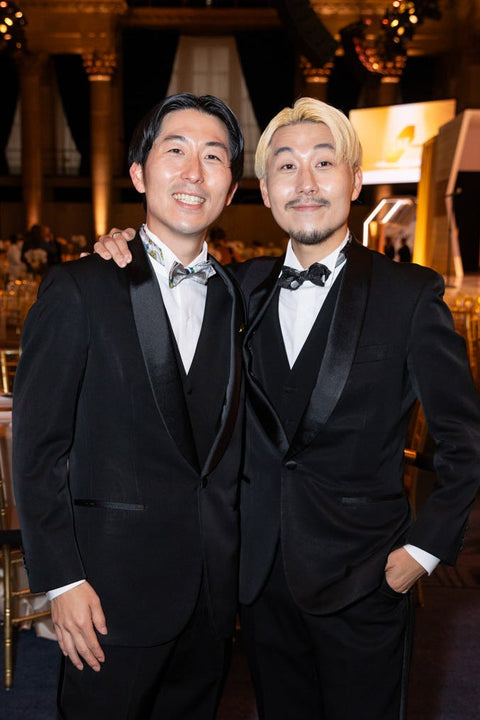
The Twin Founders of HERALBONY | FUMITO & TAKAYA MATSUDA
Changing the Way We See Art
What is HERALBONY? A company founded in 2018 by twin brothers Fumito and Takaya Matsuda, who have an older brother with an intellectual disability.
What is HERALBONY? An art licensing company connecting the work of artists with intellectual disabilities to corporations and brands.
What is HERALBONY? A word their brother used to fill his notebooks with as a child. It has no particular meaning. Sometimes, meaning isn't necessary.
What the Matsuda brothers are working toward is a society where art is valued purely on its own merits, regardless of labels or context.

HERALBONY receiving the Best of Discipline Pencil at The One Show 2026 in New York.
"We would never do anything to our brother that he wouldn't want done to him."
IROHA: What inspired you to start HERALBONY?
FUMITO: We have an older brother, Shota, with an intellectual disability. We kept asking ourselves: what kind of society would allow him to live a truly fulfilling life? In searching for that answer, we discovered the artwork created by people with disabilities at Lumbini Art Museum in Hanamaki, Iwate Prefecture.
The works there were extraordinary. And yet they were always presented under the label "art made by people with disabilities." What we felt strongly was that these works should be appreciated not because of who made them, but because of what they are — as expressions from individual artists in their own right. We believed Shota would want exactly the same thing.
The principle we hold onto is this: we would never do anything to Shota that he wouldn't want done to him.
TAKAYA: In my previous job I worked in licensing, so I thought that if we could build a system to connect these artists' works to the wider world, we might be able to shift the way people see disability. Rather than simply supporting artists through welfare, we wanted to create something sustainable as a business — because that's what would allow both the work and the artists to be recognized on fair terms. That's why we chose to establish a corporation.
"To be chosen for the work itself, not out of a sense of charity"
IROHA: What were those early days after founding the company like?
TAKAYA: Honestly, we were figuring everything out as we went. We didn't know how to raise funds, so we started by writing letters to companies and showing up in person. We were told things like, "We might consider it if it's free," or we'd be left waiting without even being shown to a meeting room. Far too often, people made their judgments the moment they heard the words "disability art."
FUMITO: Looking back, we were just a couple of young guys with no track record and no company credentials, sending out unsolicited business pitches — basically cold pitches to strangers (laughs). Even so, we refused to compromise on how we approached the work itself. We chose neckties as our first product partly because Shota loves them, but also because we wanted to make something together with Japanese craftspeople. We didn't want to simply use the artwork on a product. We wanted to create something that honored everyone involved in making it, and put that into the world.
TAKAYA: What we're after is not "please buy this because it supports a good cause." We want people to choose our products because they genuinely love them. We believe that if we keep building on that, it will gradually change how people think about disability.

HERALBONY ART PARK, a pop-up store held at Hankyu Umeda in Osaka.
"What we want to spread across the world is not a business — it's a way of seeing"
IROHA: HERALBONY has been expanding globally. What is the vision behind that?
TAKAYA: The turning point came when we met Christian Berst, a gallerist in France who specializes in art by artists with disabilities. He said to us: "Why are you only communicating in Japanese?" Those words gave us the push we needed. We also learned that there were almost no international art prizes specifically focused on artists with disabilities. So we decided to create one ourselves — that became the HERALBONY Art Prize. Now we receive submissions from around the world, and more and more people are reaching out asking us to bring their work to a broader audience. What we're doing globally is essentially the same thing we started doing in Iwate. That hasn't changed.
FUMITO: I once heard wheelchair tennis player Shunsuke Kunieda speak about what he called "the struggle to move beyond the welfare framework" — the uphill battle to be recognized not as someone deserving of support because of his disability, but as an athlete deserving of recognition because of his sport. When I heard that, I thought: we're in exactly the same fight.
We're not trying to do away with the category of "disability art." But if that label creates the impression that these are works you should support out of obligation, then that's something we need to change. We want it to be normal for art to be valued simply because it's compelling. That's the shift we're trying to make.
TAKAYA: Right now, we've earned our place on the world stage. Just as an Olympic athlete who has made it there goes on to pursue a gold medal, we want to make a real impact on the world — because we've earned the chance to try.
Our hope is for HERALBONY to become a global platform where talent from around the world can be discovered and celebrated.

Kar Hang Mui, a Netherlands-based artist and winner of the HERALBONY Art Prize 2026.
"There are battles only young people can fight"
IROHA: Finally, do you have a message for the younger generation who want to take on new challenges?
TAKAYA: We weren't aiming for the world from the start. We met people, listened to them, and thought: maybe we can actually do this. That's how it built up, one step at a time.
So my advice is: if something interests you, go and meet the people involved. And if it ignites something in you, then start. That's really all it takes.
FUMITO: When you're young, there are battles only young people can fight. A lot of people say, "I'll start once I know more." But sometimes, learning too much before you begin is its own kind of risk.
If we had waited until we felt fully prepared, HERALBONY would never have existed. Whatever you don't know, you can find someone who does and ask for their help.
The moment you think, "I want to try this," that's where it all begins.

Profile
Fumito Matsuda
Born in Iwate Prefecture in 1991. Co-CEO of HERALBONY Inc., overseeing business development, sales, and back-office operations. Prior to founding HERALBONY, he worked at a major general contractor, managing reconstruction projects in coastal Iwate following the Great East Japan Earthquake. He continues to work both in Japan and internationally with the goal of shifting society's values through art. Since 2022, he has also served as a board member of the Impact Startup Association.
Takaya Matsuda
Born in Iwate Prefecture in 1991. Co-CEO of HERALBONY Inc., leading creative direction, branding, and planning. Drawing on his background in licensing, he has built a distinctive business model connecting the work of artists with disabilities to corporations and brands. He continues to expand new possibilities for creative expression both in Japan and abroad.
Both brothers were named to the Forbes 30 Under 30 Japan list in 2019.
In 2025, both received the Minister of Education, Culture, Sports, Science and Technology's New Artist Award at the 75th Japan Arts Festival (Arts Promotion category).
Links
Heralbony
Instagram
Twins Instagram
Fumito’s Facebook
Takaya’s Facebook
written by Naomi Yokoyama | photography: Jenna Bascom (portrait, The One Show), other images courtesy of @Heralbony