
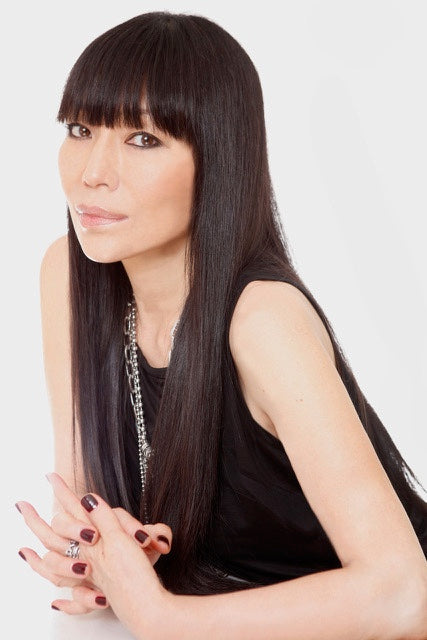
Makeup Artist / Creative Director|AYAKO
Beyond Beauty: Style, Attitude and Individuality
Why have some of the world’s most celebrated designers, artists and personalities chosen to work with AYAKO?
Her career has taken her from the runways and campaigns of houses such as Chanel, Fendi and Versace to collaborations with Penélope Cruz, Anne Hathaway, Alicia Keys, Jennifer Lopez and Naomi Campbell, as well as legendary creative figures including Karl Lagerfeld, Mert & Marcus and David LaChapelle.
What draws them to AYAKO is a visual language unmistakably her own: bold yet refined, powerful without ever losing sophistication.
A creator of beauty whose work has appeared across fashion editorials and advertising campaigns around the world, AYAKO also brought her vision into product creation as the founding Creative Director of ADDICTION by AYAKO, building the brand from the ground up.
We spoke with her in Brooklyn about beauty, fashion, color, and the philosophy that has shaped her work.

ADDICTION by AYAKO, Photo by Karl Lagarfeld
If you could have only one makeup product
IROHA: It may be a classic question, but if you could choose only one makeup product, what would it be?
AYAKO: For myself, without question, a pencil eyeliner.
Once the eyes have definition and dimension, the whole face comes into focus. And a good pencil can double as a brow pencil as well.
For me, the ultimate eyeliner is one that glides effortlessly enough to draw and smudge, but once it sets, it doesn’t move. That was exactly what I wanted when I directed the waterproof pencil eyeliner for ADDICTION.
Alicia Keys — a creative relationship spanning 26 years
IROHA: Could you tell us about some of your recent projects?
AYAKO: Over the past several years, I’ve been involved in many different creative projects and collaborations, including working with Alessandro Dell’Acqua, the designer of the Italian fashion house N°21.
Alicia Keys and I met around the time of her debut, and we’ve now worked together for twenty-six years. There is a deep level of trust between us that has developed over all those years.
Our work together has taken many forms — album covers, music videos, makeup design for concerts, the Met Gala and so much more.
There’s also this funny little thing that has followed me throughout my career — people often seem to win awards when I do their makeup. It happened with Sarah Jessica Parker, Hilary Swank, Sofia Coppola, Alicia Keys, and a Japanese actress. I don’t know why, but somehow it keeps happening.
More recently, watching her perform “Empire State of Mind” at Jay-Z’s 30th-anniversary concert was extraordinary. It was one of those moments that stays with you.

Alicia Keys in Vogue Makeup by AYAKO , Photo by Norman Jean Roy
New York: knocking on the doors of my gods
AYAKO moved from Japan to New York in the mid-1990s. She signed with an agency and began working, but the turning point in her career would not come until five years later.
AYAKO: For the first five years, not very much happened.
I had reached the point where I thought perhaps it was time to go back to Japan. But there was one thing I still hadn’t tried: working backstage at the collections.
Before giving up, I decided I had to try that. So I sent my portfolio to the makeup artists I considered almost like gods at the time — François Nars, Stéphane Marais, Kevyn Aucoin and Dick Page. And somehow, all four of them asked me to work with them.
Suddenly I found myself backstage at major fashion houses in Milan, Paris and New York.
It was unbelievably intense. I worked almost desperately hard. But when that season ended, I remember feeling something almost physical — an exhilaration that went through my entire body.
I have always loved fashion. To be surrounded by extraordinary designers and to witness their creative process from so close was invaluable.
I could see how a designer begins with an idea, how that idea becomes clothing, how a woman begins to emerge from that vision, and finally how hair and makeup complete her.
To witness beauty being constructed in that way — not simply to see the final image, but to experience how it came into being — was an extraordinary privilege.
When makeup became part of fashion
AYAKO: Of all those artists, François Nars was the one whose sensibility resonated most deeply with my own, so I chose to devote myself to working with him.
I wanted to understand everything — not only his makeup technique, but the entire world behind it. In the beginning, I was placed in the corner backstage. I was starting from zero.
I used to joke that I needed eyes in the back of my head. I paid attention to everything. I learned François’s preferences, and I immersed myself in the art and films he recommended because I wanted to understand how he saw beauty.
Once, I forgot to bring his favorite gum to Milan and ended up searching all over the city for it. That was how attentive I was.
IROHA: In 2001, you became International Makeup Director for NARS.
AYAKO: Yes. For me, it felt as though all those years of hard work had finally come together. François offered me a major contract, and I went on to work on many of the NARS campaigns as well.

AYAKO at backstage : Photo by Brian Nice
Moments I will never forget
IROHA: You have worked on so many fashion shows. Are there particular moments that remain unforgettable?
AYAKO: One was Fendi on the Great Wall of China. Karl Lagerfeld asked me to lead the makeup team.
I created an orange-toned makeup look that caught the light of the setting sun. Watching the models walking along the Great Wall in that light was so beautiful that I actually trembled.
Another important moment was the Versace charity show for Save the Children in South Africa. Working with Donatella, so many supermodels, and the makeup team I was leading gave me tremendous confidence.
We were also invited by Nelson Mandela, and the entire experience became something I will never forget.

Fendi runway at the Great Wall. Getty image
Creating something that would remain
IROHA: What inspired you to launch ADDICTION in 2009?
AYAKO: I created ADDICTION from the ground up as Creative Director.
There is something inherently ephemeral about makeup. At the end of the day, you wash it away. It can be incredibly beautiful, but by nature it disappears.
At some point, I began to feel that I wanted to create something tangible — something that could remain.
So I presented my ideas to cosmetics companies. One of them believed in me, and that was the beginning of the project.
When I began developing the products, usability was essential to me. I wanted makeup that someone could apply beautifully even without a mirror. I was equally uncompromising about color and quality.
For our first campaign, I approached Karl Lagerfeld directly and asked him to photograph it. Realistically, it seemed almost impossible because of his relationship with Chanel and the potential conflict involved.
But I asked him myself. He took my hand and said, “For Ayako, I’ll do it.” It felt like a miracle. I was incredibly happy.

AYAKO with Karl Lagerfeld : Photo by Yumiko Yoshimura
Also, art was always an important part of that vision. During my time at ADDICTION, I had the opportunity to create collections inspired by two artists I deeply admire, Jean-Michel Basquiat and Hilma af Klint, translating the colors and spirit of their work into makeup shades, with their artwork featured on the compacts. For me, it was another way of bringing art and makeup together in a tangible form.

ADDICTION by AYAKO Hilma af Klint inspired color shades
Makeup with presence
IROHA: What matters most to you when you create makeup?
AYAKO: What I care about most is creating a face that makes the person feel confident. In other words, makeup should bring out their style and attitude.
IROHA: How do you create that?
AYAKO: There needs to be a sense of intention running through the entire look — a core that holds everything together. Ultimately, the makeup should make the person feel confident.
I think of makeup almost as I think of an accessory. Makeup isn’t simply about hiding imperfections. It should be considered as part of the entire person — the clothes, the makeup, the attitude, the way they carry themselves.
And I don’t believe every part of the face needs to be “done.” Knowing what not to do is equally important.
Sometimes a single stroke of liner is enough to transform a face and give it sophistication.
For me, refinement comes from knowing what to leave out. Even when the makeup is deliberately rough, undone, or rebellious, I want there to be a certain refinement.
For a Rodarte show, for example, I created a look with mascara applied in a deliberately dirty, imperfect way. The challenge was to make it feel raw without losing its sophistication. The look made enough of an impact that The New York Times wrote about it.

Naomi Campbell Makeup by AYAKO, Photo by David LaChapelle
The skin that caught Naomi Campbell’s attention
IROHA: You are also known for creating flawless skin. We heard that Naomi Campbell particularly loved the way you did hers. How did that relationship begin?
AYAKO: I first met Naomi during that first backstage season I mentioned. She noticed the way I worked with her skin while assisting the lead makeup artist, François Nars, and later that night, she asked me to come to her room to do her makeup.
I was able to create a tone and finish that worked beautifully for her skin, and she loved it. Naomi then began telling other people about me, and in a way, word spread through her.
When it comes to complexion, I don’t particularly like correcting the skin by layering different tones underneath it. I prefer finding the foundation color that truly belongs to that person and using it to make the skin itself look beautiful.
Alicia’s skin in her twenties, for example, could also be challenging.

Naomi Campbell makeup by AYAKO, Photo by François Nars
Seeing color instinctively
IROHA: Is there a particular secret to choosing the right color?
AYAKO: Color is something I see very precisely. During my years at NARS, I did many store appearances where customers could come to the department store specifically for a consultation with me.
Very quickly, I could sense what would suit someone — not only from their complexion, but from their overall impression, what they were wearing, even the things they carried.
With color, I sometimes think I have something similar to perfect pitch in music. I can distinguish very subtle differences between shades.
That ability became especially important when I was creatively directing and developing products for ADDICTION. A blue is never simply blue. A red is never simply red. I could look at the smallest difference in tone and say, "That one. That is the color."

Makeup by AYAKO, Photo by Karim Saldi
A sense of color from my mother
IROHA: How did you develop such a strong sense of color?
AYAKO: I honestly don’t know why I can see color that way, but there is something my mother told me when I was a little girl that I have never forgotten.
We were looking at flowers growing naturally by the side of the road, and she said: “Look carefully. The most beautiful combinations of color already exist in nature. Learn from nature.” Those words have stayed with me all my life.
There are endless variations of pink, just as there are endless variations of green. And somehow, in nature, those colors find one another in combinations that feel completely effortless and completely right.I think that is where my understanding of color began.
 99 shades of eyeshadow created by Addiction.
What it takes to create beauty
IROHA: What advice would you give younger artists who want to follow a similar path? What skills or mindset do you think are necessary to succeed?
AYAKO: One thing I learned from working with people at the very highest level is that, of course, creativity and beautiful technique matter — but there are other things that reveal the quality of an artist.
The best people take care of their tools. Their tools are immaculate. They work cleanly, and they can restore order very quickly. Taking care of your tools and keeping the space around you beautiful may sound like a small thing, but I believe it reflects the state of mind from which you create beauty.
Communication is equally important. You have to understand someone’s vision and translate it into something visible. Technique matters, but your sense of beauty — and the culture behind it — needs to keep growing throughout your life.
Keep it bold
IROHA: Is there something from your approach to makeup that anyone could begin using tomorrow?
AYAKO: If I had to describe my approach, I would probably say: Keep it bold. Choose one thing and let it have impact. And always look at the entire silhouette before deciding on the makeup.

Anne Hathaway makeup by AYAKO, Photo by Roberto D'este
Style, attitude and individuality
IROHA: Finally, how would you define a beautiful woman — or a beautiful person?
AYAKO: I’m always drawn to someone with style, attitude and presence. And by attitude, I mean the confidence that comes through in the way someone carries themselves.
You don’t have to be conventionally beautiful. What interests me is individuality — someone who has developed what is uniquely theirs and has a style of their own. That was the ideal I carried with me when I created a makeup brand.
And now, I would like to create a book — a culmination of everything I’ve experienced, discovered, and come to believe about beauty, and a reflection of how I see beauty today.
PROFILE
AYAKO is a renowned makeup artist whose influence has shaped the global beauty industry for more than three decades.
Based in New York, she is celebrated for her refined aesthetic, luminous skin techniques, and fashion-driven approach to beauty, earning recognition as one of the industry's most respected creative voices.
After relocating to New York in the 1990s, AYAKO established herself on the international fashion scene, collaborating with legendary photographers including Steven Meisel, Karl Lagerfeld, Mert Alas & Marcus Piggott, and Karim Sadli, while working with iconic figures such as Alicia Keys, Anne Hathaway, Naomi Campbell, Penélope Cruz, Jennifer Lopez, and across editorial, advertising, album artwork, music videos, and runway productions.
In 2001, AYAKO was appointed International Makeup Director at NARS where she joined to shape the brand's artistic vision during a pivotal period of global expansion.
She later founded ADDICTION by AYAKO in 2009. As Creative Director for a decade, she collaborated with world-renowned creatives including Karl Lagerfeld,Steven Meisel, Karim Sadli, and Mert Alas & Marcus Piggott, producing visually striking campaigns that established ADDICTION as one of Japan's most influential prestige beauty brands.
Today, AYAKO continues to work internationally as a makeup artist, creative director, and beauty consultant, bringing her signature philosophy of enhancing individuality with effortless sophistication to everything she does.
LINKS
AYAKO's INSTAGRAM @studio_ayako