
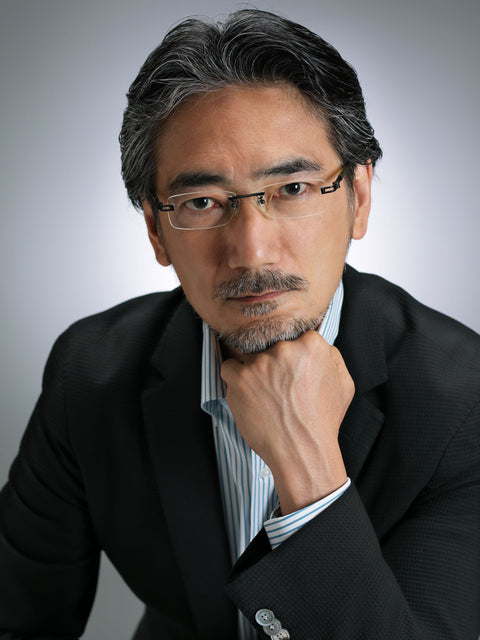
Industrial Designer Bridging Logic and Sensibility | SHIGENORI ASAKURA 朝倉重徳
The Beauty Beneath the Surface
An engineer’s eye for function and structure. A designer’s instinct for form, proportion, and presence.
Both ways of seeing run through the work of industrial designer Shigenori Asakura. He studied mechanical engineering at Waseda University before moving to the United States to attend ArtCenter College of Design. After returning to Japan, he joined GK Industrial Design, where he has worked across an unusually broad range of products—from everyday glassware to railway cars. Rather than choosing between the rational world of engineering and the intuitive world of design, he has moved between the two throughout his career.
The beauty Asakura speaks of also has more than one dimension. There is the beauty we perceive at a glance, but also a deeper kind—one that emerges when function and structure fall naturally into place, resonating with the laws of nature and with the way the human body experiences the world.
Today, as the field of design expands beyond physical objects to experiences, systems, and social concerns, Asakura has found himself thinking again about what it means to create something with physical form. Rational yet deeply intuitive, he moves between structure and sensation, logic and feeling. We spoke with him about the act of designing objects—and the deeper beauty that can emerge through them.

Where Engineering Met Design
IROHA: You originally studied mechanical engineering at Waseda University. What first led you toward design?
SHIGENORI: It was during my university years. There was a seminar on automotive engineering taught by Professor Yamanaka, who had come from an automobile manufacturer. He believed that a car wasn’t simply about mechanics and engineering; design, including the exterior, was equally part of what made a car.
Once, on a questionnaire, I wrote a single line saying something like, “I’m interested in design.” Professor Yamanaka noticed it and said, “Outside the regular seminar, I also run a small study group where I invite designers to speak. Would you like to join?”
That was the first time I really became aware that product design existed as a profession. Until then, I knew almost nothing about being a designer as a career.
IROHA: Has being exposed to both mechanical engineering and design shaped the way you work today?
SHIGENORI: I think so. I wasn’t exactly the most diligent mechanical engineering student (laughs), but that engineering mindset has stayed with me.
Through the study group, I had the chance to hear from all kinds of people, including designers who had trained at art schools. I came to understand that simply graduating with a degree in mechanical engineering wasn’t going to make me a designer, and that eventually led me to study at ArtCenter College of Design in the United States.
If I hadn’t written that one line on the questionnaire—or if Professor Yamanaka hadn’t noticed it—I might have lived a completely different life. Looking back, that was where engineering and design first came together for me.
A Deeper Kind of Beauty
IROHA: Is there one thing you consider essential when you design?
SHIGENORI: Beauty. Although explaining what I mean by beauty takes a little time. When we say something is beautiful, it can mean that it simply looks beautiful at first glance. But there is also a deeper kind of beauty—the kind we mean when we say that a mathematical formula is beautiful. That second kind is what matters most to me.
IROHA: Do you mean a kind of coherence between function and structure?
SHIGENORI: Yes. When function and structure are coherent, I would consider that part of this deeper kind of beauty.
Of course, responding to the sensibility of the times and making something visually appealing matters too. But those things can change relatively quickly. What I’m interested in is something more enduring—something closer to the essence of the object itself.
Perhaps that connects back to engineering. Mathematics and physics are ultimately consistent with the principles of the universe, with the laws of nature. Human beings exist within that same natural order, so when something resonates with those underlying principles, perhaps that is when we experience it as beautiful. At least, that’s how I think about it.
It is less about the mind deciding, “This looks beautiful,” and more about the body responding naturally. When something feels wrong, we sense discomfort. When something feels entirely natural and effortless, that is where I sense beauty.

From Glassware to Trains
IROHA: You’ve designed an extraordinarily wide range of products.
SHIGENORI: That’s true of GK as a whole, and of my own work as well. I’ve worked on all kinds of things. In my case, I sometimes describe it as “from glassware to trains.”
Our work is also a little different from that of an artist expressing a strong personal style. Rather than imposing our own preferences, we consider what is most appropriate for each project and find a way to give it form.
IROHA: Are there any projects to which you feel particularly attached?
SHIGENORI: At the smaller end of the scale, there is a series of glassware I’ve worked on with Wired Beans since its days as a startup. We started from scratch, and the project continued to grow and evolve over the next ten or fifteen years. A number of the glasses and mugs we created went on to receive Good Design Awards.
At the other end of the scale, there are railway cars. Kintetsu’s Hinotori is one of them.
IROHA: The vivid red limited express?
SHIGENORI: Yes. It’s Kintetsu’s flagship limited express, and its design concept is “dignity and refinement.” That deep red was intended to convey the sense of refinement.
But what matters isn’t simply the surface color or decoration. Take the proportions and the visual center of gravity when you look at the train from the side. By shifting the visual center of gravity slightly forward, we were able to give it a sense of strength and solidity—almost like a buffalo.
The overall form and proportions come first. The color, windows, and finer details come after that.
The challenge is how to translate an abstract idea like “dignity” into physical form. There is no formula that will lead you to the right answer. You have to work your way toward the form through an iterative process of developing and testing hypotheses.
Design is about creating balance across the whole. No single element can be perfected in isolation. You have to consider form, function, and structure together, and find a solution that satisfies them all. To me, that is what it means to design an object.

Holding On to Physical Form
IROHA: Finally, is there anything you would like to say to young people studying design or hoping to become designers?
SHIGENORI: The word “design” has come to mean something much broader than it once did.
The Good Design Award, for example, used to focus primarily on products—physical objects. Around the year 2000, sustainability and environmental concerns, and later social issues, increasingly came to be considered subjects of design as well. The field has expanded far beyond physical objects.
So when young people today think about pursuing design, many of them probably imagine designing experiences, systems, or other things that don’t necessarily take physical form.
But if someone thinks, “I still want to make objects. I want to create physical form,” I hope they hold onto that feeling. I want to encourage them.
IROHA: Why is physical form so important to you?
SHIGENORI: Physical form makes a real difference. When an object has form, you can experience it through your senses. I think that connects to physicality—to the body. You can touch it, hold it, sit on it, ride in it. There is a kind of experience that comes directly through the body.
As the meaning of design has expanded, product design may have become a relatively smaller part of the field. But I don’t think the fundamental relationship between people and objects has changed all that much.
There are endless discussions about what “design” really means. But I don’t think we need to get too caught up in definitions. Perhaps one day, people who create physical objects will no longer even be called “designers.” That doesn’t really matter.
If what you truly want is to create form, hold onto that. I think that is reason enough.

PROFILE
Shigenori Asakura
Industrial designer. President and Representative Director of GK Industrial Design Co., Ltd. After graduating from Waseda University’s School of Science and Engineering with a degree in mechanical engineering, he moved to the United States to study at ArtCenter College of Design before joining GK.
His work spans industrial equipment, public transportation, and consumer products, guided by GK Industrial Design’s philosophy: “Design for creating beauty in thinking, forms and relationships.” His many honors include the Good Design Grand Award, iF Design Award, Red Dot Design Award, and International Design Excellence Awards (IDEA). He also serves as a juror for the Good Design Award.
LINKS