
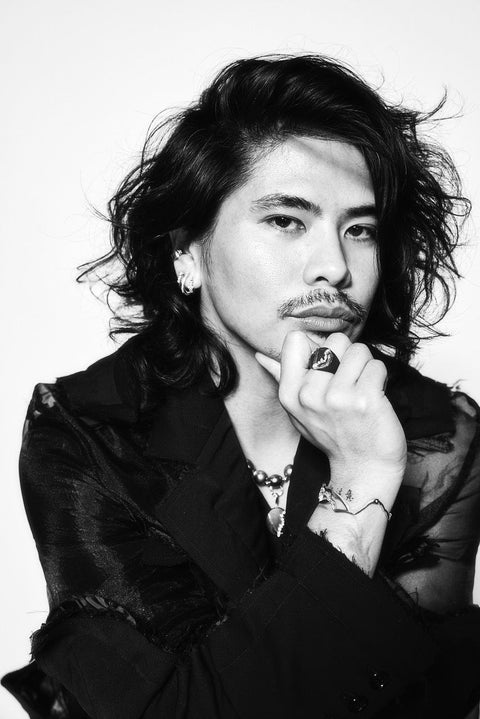
Jewelry Designer & Kintsugi Philosopher | George Inaki
George Inaki is a New York–based brand visionary, artist, and entrepreneur.
Born in Manila, Philippines, he spent his formative years in Japan from the age of 9 to 26. Drawing from his multicultural heritage—Spanish, Filipino, and Japanese—he channels this rich background into every aspect of his creative work.
After building his career in digital PR and branding in Tokyo, George founded the fine jewelry brand “Milamore” in 2019. The name is a blend of his grandmother’s name, Milagros, and the Italian word for love, “amore”.
Guided by the philosophy “Designed in New York, handcrafted in Japan,” Milamore honors the artistry of traditional Japanese craftsmanship through a distinctly modern lens.
At the heart of the brand is the signature theme of “Kintsugi”—the Japanese art of repairing broken pottery with gold—transforming fractures into beauty. Embracing the belief “Mended, not broken,” George celebrates the idea that strength and elegance emerge through imperfection.
Often referred to as the “Kintsugi Philosopher,” he intertwines design with a deeply personal life philosophy. His work has been featured in leading publications including Forbes, Vogue, WWD, Tatler Asia, V Magazine, The New York Times, and Condé Nast Traveler.
Milamore jewelry is available at the brand’s permanent Aoyama showroom, the Hankyu Umeda flagship store, Onishi Gallery in New York select boutiques across the United States, and online through Moda Operandi.

Mended, not broken
IROHA: Could you tell us about the background behind launching your brand?
GEORGE: Before I became a jewelry designer, I was in communications. My job was connecting influencers to major fashion houses. One of my clients, who is now my co-founder, asked me if I wanted to start a jewelry brand. This was in 2018. I told her, "Well, I'm not a creative person, but let me put together a proposal, and if you like it, let's do it."
When I was in school, I worked at a jewelry shop for two years and designed a few things for myself—specifically my wedding band with my ex-partner. I've always had a passion for it, but I never really thought I would become a "creative person."
Growing up with my Filipino mother, we always struggled financially. For us, creativity and all that beauty didn't really exist. I was never really exposed to creativity or the arts until I became an adult. So, it was a bit of a dilemma in the beginning.
IROHA: What projects are you currently working on?
GEORGE: After all these years, I finally understand who I am as an artist and who I am as an entrepreneur. My biggest goal is to create a heritage brand. I'm working on developing my Kintsugi collection. When I started in 2019, nobody really understood what that meant—even Japanese people, unless they were involved in tea ceremonies.
In 2020, on World Peace Day, the President of the United Nations used the philosophy of Kintsugi as a metaphor for world peace. After that, I felt like it became a universal philosophy that everyone could appreciate. When I design, I don't really think about gender or a specific type of person. I think about the silhouette of a human being, and then I design.
I think it's because I grew up in such a disadvantaged environment. I was bullied when I moved to Japan because I couldn't speak Japanese, and my family situation was very complicated. I just knew that I was going to have to start everything on my own.
That became my motivation, which I turned into design. I realized I shouldn't be the only one who feels like that. It’s not just objects that are broken and being put back together; it's the way we go through our lives and must piece ourselves back together afterward.
In Japanese, we have a phrase, "Katachi aru mono wa subete kowareru," which means that everything with a shape will eventually break. If you don't treat other people carefully, you might be destroying that person—not physically, but mentally. I really believe that Kintsugi is the universal philosophy for that.

We are currently in discussion with a national museum in Japan regarding the presentation of my work as part of a Kintsugi-focused exhibition scheduled for February 2027 in Japan.
In parallel, we are beginning a new initiative centered on transformation and renewal. Milamore will offer a repurposing program for 18K gold and platinum jewelry. Clients may bring heirloom pieces, jewelry no longer worn, or rings connected to past chapters of life, including divorce. However, this initiative will only be done in Japan at my Tokyo and Osaka stores.
Because all Milamore pieces are handcrafted in Japan, our atelier will carefully receive and rework these materials, allowing clients to exchange their own gold into a new Milamore creation. In some cases, this may take the form of a “divorce ring” or commemorative piece, created not as an ending, but as a mark of transition and self-honor.
IROHA: Why did you choose Japan as the place where your jewelry would be produced?
GEORGE: I am simply a big fan of Japanese products. When you think of Japanese products, you think they are the best, right?
IROHA: What is your experience with the "Asian glass ceiling" and breaking through it?
GEORGE: To be honest, I never really thought of it that way. The jewelry industry is very difficult to begin with, but I do think the Kintsugi concept really helped me stand out. Because I have such a strong identity, concept, and message, it made me prominent in the industry. Nowadays, everyone talks about how important storytelling is, but back then, nobody really made you feel like you were part of the design or empowered you in a real way.
IROHA: Have you ever faced the problem of anti-Asian hate?
GEORGE: I have never been physically attacked, but I did have two incidents. One time, a store owner in Kuwait said, "Oh, you didn't mention you're Filipino." She said it in a very smiley, subtle way. I thought, "Okay, we're not going to work together." I cannot erase my blood, and the brand is literally dedicated to my grandmother, who was Filipino.
The other incident involved a French-Moroccan guy who has his own brand. He said that Filipinos are disgusting because most of them are housemaids in Europe. I couldn't believe what he was saying. I’ve always thought I had a strong personality and could always fight back, but that was my very first time facing that kind of incident, and I couldn't say anything. It made me realize I am going to highlight my Philippine heritage even more.

IROHA: That is who you are.
GEORGE: That's who I am. I am Spanish, Filipino, and Japanese. It doesn't really matter what your nationality is at this point. At the end of the day, I'm just an artist. My message is all about being myself; this is what Milamore is, and this is who George Inaki is.
IROHA: What causes do you support?
GEORGE: I have a few. For me, it's Japanese craftsmanship, because it is a philosophy. When shokunin (artisans) and takumi (masters) make things, they really start with a philosophy. Japanese craftsmanship is about building things to last, unlike some other cultures.
Also, I'm very big on supporting small, individual businesses. Since I started my company, I’ve truly understood the value of money. A hundred dollars is nothing to a huge corporation, but for my company, it means a lot. I can repair something, or I can pay my team. That really changed my perspective.
When I buy things, instead of going to Whole Foods, if I want a mango, I’ll buy a five-dollar mango from the Mexican ladies on the street because those five dollars really affects their household. It comes from my own experiences; I understand the struggle, so every single dollar helps. Those two things changed my perspective.
IROHA: Is your jewelry company sourcing from small businesses?
GEORGE: Yeah. Everything is family-owned. I know the faces of my artisans. I visit my atelier every time I go back to Japan. I think showing my face and showing respect is important. At the end of the day, without these artisans, I can't make a product. Without my team, I can't build a brand or a heritage.
IROHA: What advice would you give to young people who want to follow in your footsteps?
GEORGE: From my experience: make as many mistakes as you can. I think it's better to listen to your own voice rather than everyone else's.
Throughout my career, I wasn't academically trained as a creator or an entrepreneur. I learned from all my mistakes and from the people who support me today. Everyone has an opinion; you can hear it, but I don't think you should always listen to it.
I would rather make my own mistakes based on my own decisions than do something just because people said, "You should do this or that."

And I think being grateful is very important, no matter how small or big you are. I always say: along your journey, find someone you want to be on a roller coaster with—in friendship, relationships, marriage, or business. People will come to you when you're at your high, but when you're at your low, that's when people leave. Focus on the people who support you—not just financially or physically, but those who are there for you mentally.
The people around me today are those people. My ex-partner has supported me in so many ways, without him, I don't think I could have made it. My atelier manager aligns with my vision while executing his own, and my co-founders and I share the goal of creating a heritage brand.
Friends who have supported my career since the beginning have become my collectors today. My teams in Japan and New York are still there for me, too. Those are the major things I always keep in mind.
IROHA: Outside of work, what are you most interested in?
GEORGE: Because of Milamore, I really got to explore my creativity. I’ve started creating pottery, and I do calligraphy and Ikebana. Everything is tied into the Kintsugi philosophy.
There's a Japanese word my sensei taught me. She asked, "Do you know what Hinkaku (dignity/grace) means?" She said that if you understand authenticity, you can break the rules. That blew my mind. Because I grew up without being exposed to traditional Japanese culture, I think I'm able to do what I'm doing right now.
My atelier manager always tells me that because I wasn't traditionally trained as a jeweler, I was able to envision the idea of Kintsugi jewelry.
At the end of the day, you only live once. When I die, I want to be able to say, "I did that; I created that." I believe my Kintsugi will live forever.

geoge with his team
Interview by Susan McCormack, written by Eri Kurobe, Photography Courtesy to Milamore and George Inaki
LINKS