
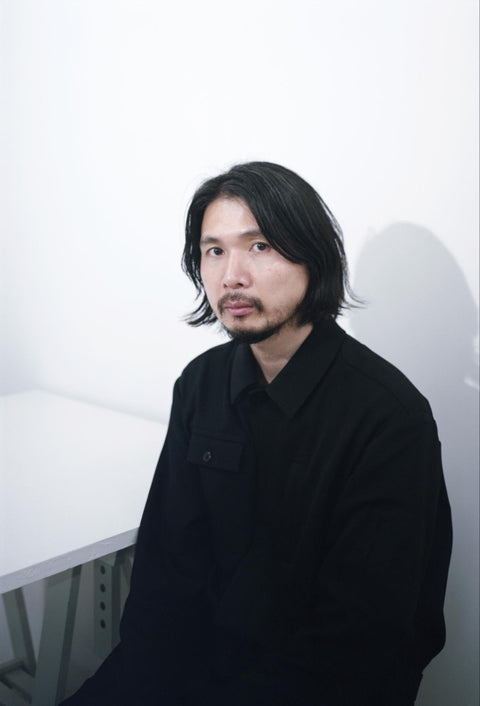
Fashion Educator and Founder | Yoshikazu Yamagata
Where Expression Lives
Yoshikazu Yamagata grew up in Tottori, dropped out, and left for London alone. What he found there—at Central Saint Martins, and later in John Galliano’s studio—would go on to shape the philosophy he teaches today. We spoke with the founder of coconogacco about how that philosophy takes form.

Works by Tomohiro Shibuki, coconogacco exhibition, Fuji Textile Week
A Place to Think, Not Just Make
IROHA: What are you working on these days?
YOSHIKAZU: I’m currently focused on two main projects: running my fashion school in Tokyo and developing a new research program based in Itoshima, Fukuoka.
At the school, we place emphasis on concept-making—approaching design and creativity through history and culture. Japan already has many excellent institutions that teach sewing techniques and garment construction, so we intentionally chose a different path.
Much of Japanese fashion education developed through the import of Western systems—how to produce and how to consume. These structures were built during an era of mass production and mass consumption, and they still remain deeply rooted today.
What I wanted to create instead is a place where people can think for themselves—
to ask, here and now in Japan: what can be made?
And what is it that I truly want to express?
The program in Fukuoka is called the Cocoa Self and Field Research Association (commonly known as “cocoa”). It was relaunched last year as a monthly overnight program, with around ten participants ranging from middle school students to people in their forties.
Each session takes place in a different setting—temples, beaches, mountains. We hold guest sessions, engage with local communities, and meet craftspeople in the region.
I want it to be a place where people can learn from the diverse ways of living found across Japan.

Cocoa Self-Field Research Association in Itoshima
The First Place That Felt Like Mine
IROHA: Does your teaching philosophy stem from your experience at Saint Martins and with Galliano?
YOSHIKAZU: Very much so.
Before that—through primary school, secondary school, and vocational school—I never once felt I truly belonged anywhere. Central Saint Martins was the first place where I felt, “This is where I belong.”
There’s a strong punk spirit there—a freedom to break rules. No one tells you that what you’ve created is wrong. I had never experienced anything like it.
Galliano’s studio was another world entirely—a place where dreams and madness coexisted. People gathered from all over the world, the workload was almost impossible, and yet after each show, everyone would come together, watching footage of Galliano’s dramatic entrances and laughing.
It was demanding, but also deeply warm.
His philosophy was “Everybody is beautiful.” Even things that might be seen as flawed were approached with an open sense of possibility. Seeing that philosophy embodied at such a scale—within a house like Dior—confirmed something I had long felt but never seen proven.
That experience continues to support me today.
Recently, I had the chance to sit down with the current fashion directors of Central Saint Martins and the Royal Academy of Fine Arts Antwerp when they visited our school.
One of them said, “You’re actually working more freely than we are.”
Their institutions are national or royal academies, where students are required to meet certain quotas in order to advance. We don’t have that.
Hearing that made me realize something.
People of different ages, backgrounds, and disciplines gather here, sharing the broad theme of fashion, and learning freely.
In that moment, I became newly aware of the value of such a place.

Biotope (Yudai Tanaka & Anna Tanaka), coconogacco exhibition, Fuji Textile Week
Choosing to Begin Alone
IROHA: Have there been difficult moments along the way?
YOSHIKAZU: To be honest, there was friction with established institutions.
After returning to Japan, I was invited to help launch programs and give lectures at various schools. But when I tried to introduce approaches that didn’t exist within these institutions, I often encountered resistance. I wasn’t trying to fight, but that’s how it felt at times. Eventually, I decided: I’ll just do it myself.
Another ongoing challenge is sustaining motivation.
At schools like Saint Martins or Antwerp, highly driven individuals gather from around the world, naturally creating energy. My environment is different.
So I focus on meeting each student where they are, and drawing out what already exists within them.
When someone shares something they feel ashamed of—something they’ve hidden, a sense of inferiority or weakness—I tell them: that’s okay. That feeling is exactly where your expression lives.
I’ve seen something shift in people in those moments, time and again.

Works by Yu Kawajiri, coconogacco exhibition, Fuji Textile Week
The Self You Haven’t Met Yet
IROHA: What would you say to young people pursuing creative work?
YOSHIKAZU: The self you believe you are, and the self you truly are, are probably different.
So please—never close off the possibility of encountering a version of yourself you haven’t yet met.
The things you feel insecure about. The parts of yourself you see as flaws. The things you hide because you don’t want others to see them.
Those are often the very things that only you can carry—your sensibility, your perspective, something no one else can replicate.
Growing up in a place with limited access to information, or not fitting in at school—those experiences give you something.
I wouldn’t necessarily call them strengths. But there will come a moment when they become the core of your expression.
I know this from my own life, and I see it in my students.
Keep searching.
Somewhere, at some point, you will encounter a place or a moment where you think: this is it.

Works by Hana Yagi, coconogacco exhibition, Fuji Textile Week
Learning Life, All Over Again
IROHA: What do you enjoy outside of work?
YOSHIKAZU: Watching my child grow.
Every day brings something new—small discoveries, quiet moments of joy in seeing a person develop.
None of us remember what it was like to be two years old. So when I watch my child, I sometimes feel like I’m discovering answers to questions I didn’t even know I had.
It’s a strange and beautiful experience.
Yoshikazu Yamagata
Fashion designer and educator. Born in Tottori, Japan. After graduating from Central Saint Martins, he worked as an assistant to John Galliano.
In 2005, he returned to Japan and founded his fashion label writtenafterwards, along with his private school coconogacco, which has produced many designers and artists.
His teaching is centered on the exploration of self and society, as well as fashion as a form of expression.
He currently leads the Cocoa Self and Field Research Association, based in Itoshima, Fukuoka.
written by Naomi Yokoyama / photography: Takashi Homma (portrait); all other images courtesy of coconogacco
Links
Yamagata Yoshikazu Instagram
coconogacco
Cocoa Self and Field Research Association
writtenafterwards