
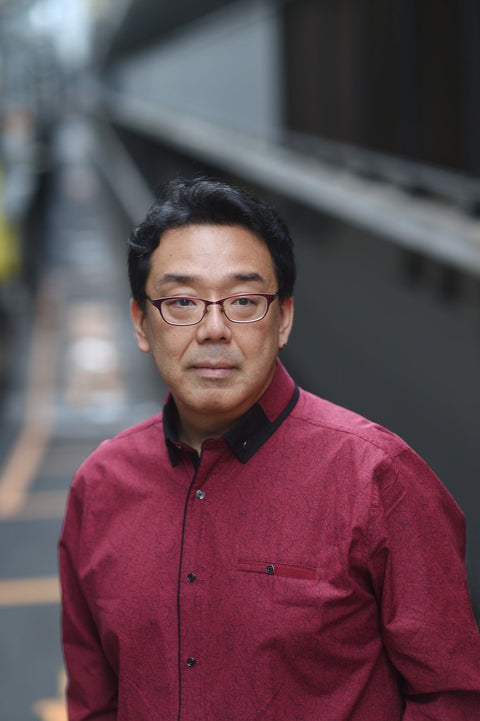
The Broadway Sound Wizard | Hiro Iida ヒロ・イイダ
The Man Who Creates the Sound of Angels Walking on Clouds
"Make it sound like an angel walking on clouds."
That's the kind of request Hiro Iida receives on Broadway.
As one of Broadway's leading Electronic Music Designers, he has helped shape the sound of acclaimed productions including “MJ: The Musical”, “The Lost Boys”, “The Band's Visit”, and “Kimberly Akimbo”.
Ironically, the man who now creates some of Broadway's most memorable musical moments once disliked musicals altogether.
We visited Hiro's studio to learn how he found his way to Broadway—and how he transforms imagination into emotion through sound.

Hiro at his studio
“Musicals? I Hated Them.”
Hiro Iida was raised in Tokyo and studied electronic music in Boston, at the Berklee College of Music. After graduation, he worked as an instructor before moving to NYC.
IROHA: So, Broadway wasn't your original goal?
HIRO: No, not at all. In fact, I hated musicals. (Laughs.)
They felt overly theatrical to me.
I loved opera and regularly attended performances at the Metropolitan Opera, but I rarely watched musicals.
At the time I was working in recording and engineering in New York and eventually found myself creating all sound for the WWE, like wrestlers’ entrance themes and sound effects.
Then my business partner approached me about a project and said, "Are you interested in working with U2?"
That immediately caught my attention.
That project turned out to be “Spider-Man: Turn Off the Dark”.

On his studio's wall
The Audience That Opened My Eyes
IROHA: When did your opinion of musicals begin to change?
HIRO: During the national tour of “Shrek the Musical”.
We were doing technical rehearsals in Yakima, Washington.
When we finally invited a public audience into the theater, I experienced something that completely changed my perspective.
The audience wasn't like a typical New York theater crowd.
Kids were talking. People were moving around. Nobody seemed concerned with theater etiquette. (Laughs.)
But emotionally, they were completely open.
When something was funny, they laughed loudly. When a scene was sad, they cried. When a character became angry, they became angry too.
Watching that reaction was a revelation.
I realized that a single sound could dramatically influence people's emotions.
That's when musicals became fascinating to me.
Dance, lighting, dialogue, music—everything works together to guide an audience's emotions.
For the first time, I truly understood the power of musical theater.

Creating the Sound of an Angel Walking on Clouds
IROHA: What exactly does an electronic music designer do?
HIRO: A synthesizer has two major functions.
The first is reproducing sounds that already exist.
You can create something that sounds like a violin, the wind, or birds singing. It’s a tool for simulation.
The other is creating sounds that have never existed before.
Imagine someone says, "I want the sound of an angel walking across the clouds."
Nobody knows what that sounds like.
But my job is to create a sound that makes people instantly say, "That's it."
On a Broadway production, the composer writes the music first, and then the orchestrator adapts it for the stage.
At that point, additional sonic elements are often needed.
Sometimes an orchestrator will ask for a richer string texture or a particular brass sound, and I create it.
Other times the instructions are entirely abstract: "Make it soft and expansive," or "Give it a sense of floating."
My job is to transform those verbal descriptions into actual sound.
Sometimes a score literally contains notes like, "Make this feel as if someone is walking on clouds."
Realizing those ideas is entirely an exercise in imagination.
And on Broadway, I'm expected to do both—recreate reality and invent sounds that have never existed before.

4 Tony awards winner, " The Lost Boys"
The Boy Who Learned Synthesizers at Ten Years Old
IROHA: When did you first discover synthesizers?
HIRO: I was probably in third or fourth grade.
My older sister introduced me Isao Tomita's “Clair de Lune” album.
It completely blew me away. I remember thinking, “I had no idea music like this existed.”
Around the same time, Roland opened a showroom in Akihabara, Tokyo.
Every Sunday, professional musicians and engineers offered free workshops there.
I started attending when I was about ten years old.
Everyone else was either a professional or a graduate student. I was the only kid there.
But children absorb things quickly. Before long, I was learning faster than everyone else.
Eventually I became more interested in experimenting with the synthesizers than attending the lectures.
The instruments were modular synthesizers—the kind that don't produce sound until you connect the cables yourself.
That's when I developed an intuitive understanding of sound design.
For me, creating sounds feels like riding a bicycle. Most people can't remember exactly how they learned to ride one, but once you've learned, you never forget.

" The Band's Visit" swept the 2018 Tony Awards, winning 10 awards
The Ability to Analyze and Rebuild Sound
IROHA: What makes synthesizers fascinating to you?
HIRO: A synthesizer is a machine that synthesizes sound. The opposite of synthesis is analysis.
If you can analyze a sound, you can rebuild it.
It's like how a skilled chef can taste a bowl of ramen and immediately understand what ingredients were used and how the broth was prepared.
That's how sound works for me.
The moment I hear a sound; I can break it down in my head and understand what it's made of and how it's constructed.
Then I can recreate it.
For years I assumed everyone experienced sound this way. But after working with many different people, I realized it's a rather unusual ability.
I also have a very long memory for sound.
I can still remember the timbre and texture of recordings I heard decades ago.
Sound normally disappears the moment it's heard.
But for me, it's almost like having a photographic memory for audio. I can replay sounds in my head, analyze them, and recreate them years later.
Because of that, making music with synthesizers has always felt natural to me. It's simply my instrument.

Tony Award-winning new musical, "The Great Gatsby"
Recreating Michael Jackson Without Copying Him
IROHA: A show like “MJ: The Musical”, based on a real-life icon, must present a different kind of challenge.
HIRO: Absolutely. Everyone knows Michael Jackson's music.
If even one detail feels slightly off, audiences notice immediately.
But at the same time, simply reproducing the original recordings isn't enough.
When you listen to those recordings today, you can hear the era they came from.
And theater is different from a recording studio. The sound must fill a large space and support a live performance.
If you copy too closely, it doesn't work. If you change too much, it stops feeling like Michael.
Finding that balance was incredibly difficult.
Representatives from the Michael Jackson Estate would occasionally play original master recordings for us. We weren't allowed to record them.
We had to memorize what we heard and recreate it from memory.
And once we finished, those same representatives would listen and evaluate our work.It was nerve-racking.
IROHA: I've seen “MJ”, and as an audience member I felt as though I was hearing the Michael Jackson I remembered. That's quite a magic trick.
HIRO: That's exactly the goal.
We kept refining the sound until the very last possible moment.
Most Broadway productions have a preview period of about thirty days. During that time, changes are made daily.
Eventually, a production reaches what's called a "freeze," the point when no further changes are allowed.
But “MJ” had a sixty-day preview period.
We were adjusting almost every day.
People from the Estate joked that everyone involved had become perfectionists, as if Michael himself had taken over the room.
We were still making tiny adjustments right up until the end.

Stepping onto the red carpet at the opening night of MJ:The Musical"
Only Five People in the World
IROHA: Your profession is quite unusual, isn't it?
HIRO: Very. People often confuse what I do with sound design.
Traditional sound designers focus on speakers, microphones, and theater systems.
My work is electronic music design.I create tracks, playback systems, time-code workflows, and the electronic infrastructure behind a production.
Even on Broadway, this role didn't exist when I started.
Today, there are probably only five or six people in the world doing this work at the highest level.

with Brian May and Roger Taylor of Queen. Hiro worked for " We Will Rock You US Tour"
Aiming for 140%
IROHA: What does it take to survive at the highest level?
HIRO: You must give 140 percent. One hundred percent isn't enough.
Broadway is a place where you're expected to deliver every single time.
It's like stepping up to the plate ten times and being expected to get ten hits—or maybe even ten home runs.
If you stop exceeding expectations, someone else is ready to take your place. That's simply how competitive it is.
My job is to transform the sound a composer hears in their imagination into something real.
When someone says, "This is the sound I'm looking for," I must be able to create it.
That's what keeps me working.

With Baron Lloyd-Webber
Opportunity Doesn't Wait
IROHA: What advice would you give young people who dream of working on Broadway?
HIRO: Don't miss opportunities. People talk about the American Dream, but opportunities really do appear in New York.
The problem is that many people aren't prepared when they arrive.
I often compare it to a conveyor-belt sushi restaurant.
Delicious sushi keeps passing right in front of you, but some people simply watch it go by.
No matter how much great sushi appears, if you don't have the ability—or the courage—to reach out and take it, you'll never get to eat it.
For people coming from overseas, preparation matters.
You need the proper visa. You need legal status. You need skills. You need training.
Sometimes an opportunity appears unexpectedly.
Someone asks you, "Can you come tomorrow?" And if you answer, "Sorry, I have part-time job tomorrow." It doesn’t work.
There are plenty of opportunities here and there are also plenty of people ready to take them if you don't.
That's why you must keep pushing yourself beyond what you think is enough.

With Hans Zimmer at the opening night of " MJ"
Musicals based on Prince and TLC
IROHA: Could you tell us about some of the projects you've been working on recently.
HIRO: One of the productions I recently worked on, “The Lost Boys”, received 12 Tony Award nominations in 2026 and won four of them.
Currently, “Freak the Mighty” is in its tryout phase, as well as “Purple Rain Broadway”, a stage adaptation of PRINCE’S film. Next, I'll be working on “CrazySexyCool, the musical based on TLC.
In Japan, I'll also be involved in Akiko Yano Trio's summer concert tour and the musical “Princess Anio”, which is scheduled to open in September.

With the Akiko Yano Trio — and Hiro, who’s often joked about as the unofficial fourth member.
The Thrill of Reinvention
IROHA: After all these years, what keeps Broadway exciting?
HIRO: Every project forces me to try something new.
A new sound. A new technique. A new way of thinking.
If a project only required eighty percent of my abilities, I could hand it to an assistant.
The joy of Broadway is that every production demands something I've never done before.
That's what keeps it exciting.
Written by Eri Kurobe, Photography: Courtesy of Hiro Iida
PROFILE
Hiro Iida is widely recognized as a leading electronic music designer based on Broadway in New York.
Known for his cutting-edge sound production using synthesizers and computer technology, he has made significant contributions to the development of electronic music systems in Broadway productions.
Raised in Japan, Iida moved to the United States in 1985. After graduating from Berklee College of Music, he taught electronic music there for six years and was honored as Best Teacher by the International Association for Jazz Education.
After relocating to New York, he worked for nearly three and a half years composing music for WWE.
His involvement in the Broadway musical “Spider-Man: Turn Off the Dark” marked his entry into Broadway. There, he developed a groundbreaking computer-based music system capable of reproducing the same sound quality consistently throughout long-running performances.
His major Broadway credits include The Lost Boys, MJ :The Musical, The Great Gatsby, Notebook Musical, Mean Girls, Tootsie, The King and I, Shrek The Musical, Beautiful: The Carole King Musical, The Band's Visit, and Kimberly Akimbo among many other musicals.
He has received two Grammy Awards.
Internationally, his work includes the Korean musicals Mata Hari and Xcalibur, as well as Japanese productions such as King Arthur, Death Note: The Musical, Ikiru, and Your Lie in April.
He has also been responsible for the sound design of performances by Akiko Yano for many years.
LINKS
Instagram @noblyrotten_hiroism