
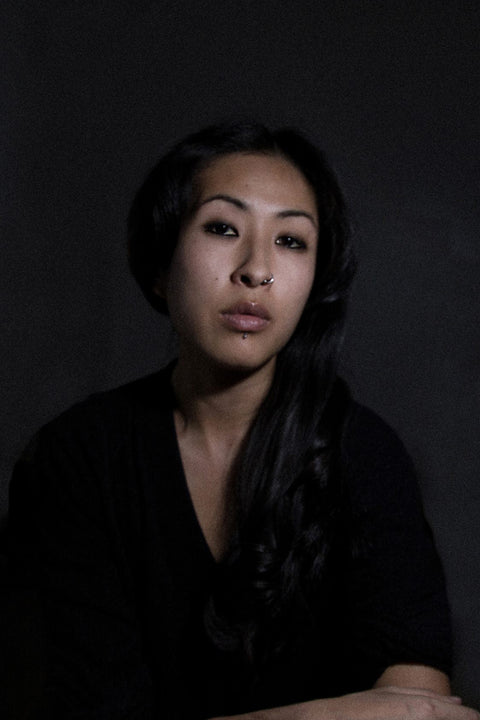
Documentary Photographer | Haruka Sakaguchi
Uncovering Untold Stories Through the Lens
Through photographs and handwritten voices, acclaimed documentary photographer and filmmaker Haruka Sakaguchi explores what remains across generations --- memory, identity, and the stories families carry in silence.
From Hiroshima survivors to Japanese American incarceration camps, her work uncovers untold histories that continue to shape the present.
We spoke with her about photography and the stories that refuse to disappear.
Pilgrimage to Places That Hurt
IROHA: Could you tell us about your recent exhibition "The Camps America Built" and also working on a film connected to the project?
HARUKA: The short film "Loyal American," is a part of this larger project called "The Camps America Built," which was featured and exhibited at the International Center of Photography.
"The Camps America Built" is a project that addresses Japanese Americans who were incarcerated in camps during World War II.
Since 2022, I've been visiting all 10 permanent incarceration camps across the U.S., joining former incarcerees and their descendants on pilgrimages back to these places.
What fascinated me was the idea of pilgrimage itself. In Japan we have "O-Henro", journeys to sacred places.
But I've realized through working on this project that for many Japanese Americans, visiting these sites of pilgrimage means returning to a site of trauma.
There's a lot of deep humiliation and suffering that's associated with these sites.
Many former incarcerees may be very resistant to go back, like, "Why would I go back to these remote areas I've associated with these dark moments?"
Yet families keep returning --- sometimes for closure, sometimes for healing, and sometimes to reconnect with parts of their history that had been left unspoken.
Now, almost 80 years later, I'm seeing younger generations --- Yonsei, Gosei --- becoming deeply curious about family stories that were once buried in silence.

From the exhibition "The Camps America Built" at the ICP
Documenting the Human Side of History
IROHA: One of your first major projects focused on Hibakusha --- atomic bomb survivors. What initially made you want to photograph them?
HARUKA: Growing up in the United States, I remember my history teacher in fourth grade calling the atomic bombs a necessary evil, that it was a military necessity in order to end World War II and then save even more Japanese and American lives.
So, there was this kind of moral justification that I did not agree with. And there was no discussion of what happened to the atomic bomb survivors afterwards.
I wanted to understand the human side of that history.
You hear about the hundreds of thousands of deaths, but you don't really think about what happened to those who survived and who are still with us.
Because I live in the United States and work primarily in English, I felt a responsibility to make these stories accessible to people who otherwise might never encounter them.
These histories already existed within families and communities, but many had not entered broader public conversations.
 "1945" Courtesy of Haruka Sakaguchi
A Rejection That Changed Everything
IROHA: What led you to begin documenting Japanese incarceration camps?
HARUKA: Interestingly, it started with a rejection email.
In 2021, I was covering anti-Asian violence following the Atlanta spa shootings for National Geographic Magazine.
I was supposed to photograph a Japanese American family, but the father withdrew at the last minute.
His daughter explained that her father came from a "No-No" family.
I was like, "What is a no-no?"
During their incarceration, Japanese Americans were required to complete a government loyalty questionnaire.
Those who answered "no" to two key questions about military service and allegiance to the U.S. became known as "No-No Boys."
Families were split apart depending on their answers, and in some cases those fractures remained for generations.
The father thought it may inconvenience or trouble some of his other family members.
I grew up in California surrounded by Japanese American communities, yet my history textbook was a paragraph and a half about this history, let alone having discussions about the loyalty questionnaire.
I remember thinking: "If I don't know this, how many other people don't know it either?"
That question stayed with me.

From the exhibition " The Camps America Built" at the ICP
The Power of Co-Authorship and Handwritten Voices
IROHA: One thing I noticed in your work is that you often include handwriting and text in the images. Why is that important?
HARUKA: Co-authorship has always been central to my work.
I first started incorporating handwriting while working on "1945", my project with Hibakusha --- atomic bomb survivors from Hiroshima and Nagasaki.
I'm not a Hibakusha. I'm an outsider to that experience. I also knew I was creating work for an English-speaking audience, and I worried about becoming the sole interpreter of someone else's story.
So, I asked participants to write letters.
For the Hibakusha project, they wrote letters to future generations.
For the camps project, I changed the approach.
Because there was so much silence surrounding incarceration, I asked former incarcerees to write letters to their younger selves, and descendants to write letters to family members.
Sometimes the most honest things emerge when people aren't speaking directly to an audience.

"1945" Courtesy of Haruka Sakaguchi
The Privilege of Heritage and Language
IROHA: Did documenting these stories change the way you think about your own identity?
HARUKA: Very much so. I met many younger Japanese Americans who were trying to reclaim parts of themselves that had been lost.
Their parents or grandparents often stopped teaching Japanese after the war.
Some families wanted to become not just American, but hyper-American --- to protect their children from stigma.
I met people learning Japanese from scratch because they couldn't learn it from their own families.
And it made me realize how much I had taken for granted.
Growing up, I sometimes resisted Japanese school and language lessons.
But through this project I began understanding what a privilege it is to have access to your own language and culture.
My relationship with my Japanese identity became something that I no longer take for granted.
After working on this project, I started to realize how fortunate I am to have access to my language and my cultural heritage.

"Typecast" Courtesy of Haruka Sakaguchi
The People in Front of the Camera Are Not "Subjects"
IROHA: What philosophy guides you as a documentary photographer?
HARUKA: Traditional journalism can sometimes be extractive.
Historically, people entered communities they didn't belong to, collected stories, and left.
I think a lot about how to avoid that.
Even the word "subject" feels uncomfortable to me.
People who stand in front of my camera are giving me their trust and their time. I don't want them to simply become material for a story.
I want them to shape the story itself.
That's why collaboration matters so much in my work.

From the exhibition "The Camps America Built" at ICP
Your Other Job Is Not Your Weakness
IROHA: What advice would you give the younger generation who want to be a documentary photographer?
HARUKA: I would say not to feel ashamed if they need another job to support their work.
Early in my career, I felt insecure because I was working as both a designer and a photographer.
I worried that having another source of income made me less credible as a photojournalist.
But now I see it very differently.
Supporting your art through other work does not dilute your creativity --- it can actually protect it.
As the media landscape continues to change, having different experiences and being part of communities outside of photography can broaden your perspective and make you a stronger storyteller.
 My Parents Expected to Be Retired. Instead, They Are Raising My Sister’s Kids.The New York Times Magazine
Memory Doesn't End with One Generation
IROHA: Across all your projects --- "1945", "The Camps America Built", "Typecast"--- is there a common thread?
HARUKA: I think there is.I do have a focus on generational memory and how things that have happened to us in the past or how revisiting the past informs the present.
It informs how people make decisions around their own lives and their loved ones, how that informs policy, how that forms identity, which I think is ever-changing across generations.
I am interested in this idea of generational memory and how we interpret memory across generations.
" "The Camps America Built" at ICP
written by Eri Kurobe. Photographs: Courtesy of Haruka Sakaguchi
LINKS
PROFILE
Haruka Sakaguchi is a Japanese documentary photographer and filmmaker whose work explores memory, identity, and belonging.
Born in Osaka, Japan, and raised in the United States, Sakaguchi brings a nuanced perspective to questions of migration, cultural inheritance, and national identity.
She is widely recognized for documenting the experiences of “hibakusha”—survivors of the atomic bombings of Hiroshima and Nagasaki—in her long-running project “1945”, as well as for exploring Asian American identity and representation through projects such as Typecast and I Will Not Stand Silent.
One of her most significant recent projects is “The Camps America Built”, an ongoing multimedia documentary examining the legacy of Japanese American incarceration during World War II.
Expanding beyond still photography, Sakaguchi directed “Loyal American”, a short documentary film produced in partnership with the National Geographic Society.
Sakaguchi’s photographs have been published by National Geographic, The New York Times, TIME, and The New Yorker, The Washington Post, Smithsonian Magazine, BBC, Bloomberg Businessweek, ProPublica, and NPR, among many others.
Sakaguchi’s work has been exhibited internationally at institutions including the Nobel Peace Center in Oslo, Osservatorio Fondazione Prada in Milan, Prada Aoyama in Tokyo, Photoville in New York and Los Angeles, and the International Center of Photography (ICP) in New York.
Her work is recognized for its emotional depth, visual sensitivity, and commitment to preserving stories that might otherwise be forgotten.