
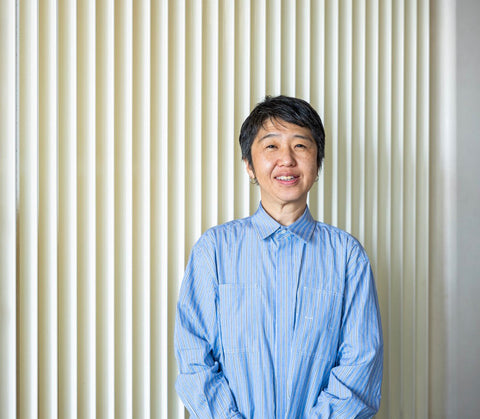
Everyday Life, Observed | Momoyo Kaijima 貝島桃代
Architecture for the Joy of Living
Momoyo Kaijima is an architect, researcher, and educator based in Zurich and Tokyo.
Momoyo’s approach—designing space through careful attention to human behavior and surrounding environments—has been systematized as Architectural Behaviorology, and is widely referenced in architectural practice and education around the world.
Momoyo has also collaborated with medical institutions. Since 2005, she has worked with several hospitals, including the University of Tsukuba Hospital, on projects such as rethinking corridor spaces, organizing exhibitions, and introducing art programs. These activities were later organized as an NPO called Cheer Art.
In education, after teaching for nearly twenty years at the University of Tsukuba, she is now based at ETH Zurich, where she works across education, research, and architectural practice.

Muginoko School (2025)
Living Through Design
IROHA: Among all your work so far, is there a project that feels especially meaningful to you?
MOMOYO: It’s very difficult to choose just one. For me, what matters most is the ongoing process of enjoying and learning from architectural design as part of everyday life.
I realize that long before modern architecture arrived in Japan, people had already been building for thousands of years. There is a deeply rooted architectural culture in Japan, shaped by local ways of living and methods of building that existed well before Western technologies were introduced.
Architecture emerges from people’s efforts to improve their lives and environments. With that accumulated cultural context in mind, I’m interested in seeing architecture as a way of recording how people live.

Kurimoto Daiichi Firewood Supply Station (2018)
Drawing as a Shared Language
IROHA: You also have a distinctive approach to architectural drawing.
MOMOYO: Drawings are usually communication tools among professionals, but I have wanted to develop them into a kind of “language” that can also be understood by the general public.
Through a series of drawings—such as guidebook-style diagrams or black-and-white illustrations that include daily life and surrounding environments—I hope architecture can feel more approachable and visually accessible.


Drawings from SWJ Selection
Windows as Cultural Evidence
IROHA: Your research on Swiss windows has received significant attention.
MOMOYO: I looked at around seventy windows across Switzerland, spanning from the past to the present. Switzerland has strong regional identities, and grasping the country as a unified whole can be difficult even for the Swiss.
Perhaps because I am an outsider, I was able to offer a perspective that felt fresh, and that may be why the work resonated.
When you compare the history of windows, you can see how climate shapes culture.
Japan, with its relatively mild climate compared to Switzerland, has long had a more open approach to windows. In Switzerland, the colder climate meant small openings at first, and only with the introduction of glass in modern times did windows become larger and more open.
In Japan, before glass, shoji (sliding paper screens) functioned as windows. Even today, people use curtains and change them seasonally. These cultural differences surrounding windows are endlessly fascinating to me.

Koisuru Buta Laboratory (2012)
Designing Care Environments
IROHA: Could you tell us about your art and design projects in university hospitals?
MOMOYO: It began when the University of Tsukuba Hospital approached us, saying the building felt old, dark, and tense, and asked whether art and design could help bring more warmth and vitality into the space.
In hospitals, every area is part of the medical environment—for patients, families, and staff alike—and there is very little room to relax.
We chose to focus on the connecting corridors, spaces not directly assigned to any department.
By renovating them, introducing art exhibitions, and inviting students to participate as artists-in-residence, we were able to create moments of relief.
Medical care is always the top priority in a hospital, of course, but even in the hardest moments, people still seek a sense of joy and vitality.
These activities were later organized as an NPO called Cheer Art, and today we work with multiple hospitals on environmental improvements and the design of family waiting areas.
Learning Across Disciplines
IROHA: Do you have any advice for young architects and students?
MOMOYO: First, stay healthy. Creating good work requires physical strength and energy.
And keep your curiosity alive—learn broadly about culture, history, and society. Trying to understand things deeply will eventually help you develop your own voice.
Don’t be afraid to ask questions, to make mistakes, and to keep learning.
In Switzerland, people grow up navigating multiple languages and cultures, so discussions often include historical and political contexts. In Japan, communication is often based on reading the atmosphere within a shared culture.
Both have their strengths, and I feel I am still learning by experiencing both.

Birds Theatre Annex (2025)
New Communities on the Water and the Slopes
IROHA: Finally, is there anything you’ve been enjoying recently outside of work?
MOMOYO: I’ve returned to skiing, and I’ve started rowing with a boat club on Lake Zurich.
Through these activities, I’ve met people outside the worlds of architecture and academia. Spending time in nature and connecting with new communities has been a meaningful way to expand my world.
PROFILE
Momoyo Kaijima co-founded Atelier Bow-Wow with Yoshiharu Tsukamoto in 1992. The practice is known for its distinctive research approach rooted in close observation of small-scale urban spaces and for realizing a wide range of projects both in Japan and internationally, including housing, community facilities, public spaces, and exhibition design.
Notable works include MINI house (1999), JIG (2003), House & Atelier Bow-Wow (2005), BMW Guggenheim Lab (New York, 2011), Koisuru-Buta Laboratory (2012), Kurimoto Daiichi Firewood Supply Station (2018), Home for All Minami-Aso (2021), Chestnut Tree Library (2023), and Bird Theatre Annex(2025).
Her publications include Made in Tokyo (1998), Graphic Anatomy (2007 / 2014), Behaviorology (2010), and Swiss Window Journeys: Architectural Field Notes (2023).
Awards include the Yoshioka Award (1999), the American Wood Design Awards (2002), the RIBA International Fellowship (2012), and the Wolf Prize in Architecture (2022). In 2018, she also served as curator of the Japan Pavilion at the Venice Biennale of Architecture.
Written by Naomi Yokoyama / photography: Tomo Ishiwatari(portrait, Kurimoto Daiichi Firewood Supply Station), All other images courtesy of Atelier Bow-Wow / Architecture: Atelier Bow-Wow
LINKS