
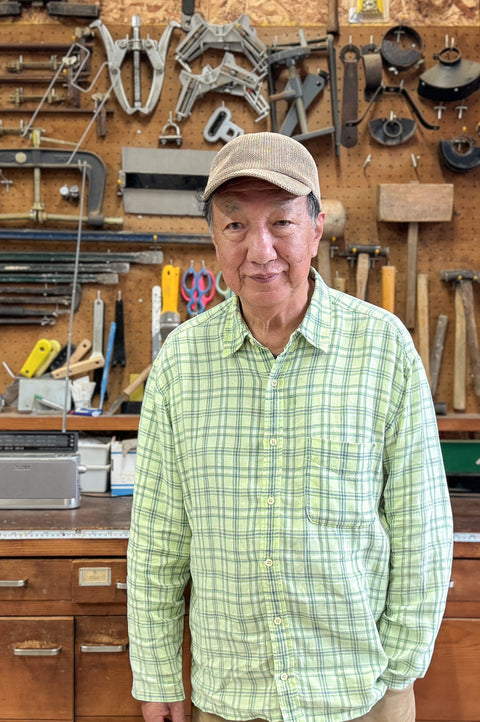
Exploring Systems | Kazuo Kadonaga 角永和夫
"I never set out to make a form. The form just appeared."
Contemporary artist Kazuo Kadonaga has spent his career moving through materials — wood, bamboo, paper, silk — before arriving at glass. Rather than shaping form, he uncovers the structures and time embedded within each material, designing the systems through which a work comes into being. "I've never made paper, never blown glass." We spoke with him about the quiet curiosity and conviction that have guided more than half a century of making.

A Glass Work Twenty Years in the Making
IROHA: What projects are you currently working on?
KAZUO: Late last year, I finally completed a large glass work I had been imagining for many years. I first chose glass as a material in 1991, and presented my first works in Tokyo in 2000. In the ten years between, I showed nothing — not glass, not anything else.
When I built my glass studio thirty years ago, I set myself a goal: to create three large works. The first was completed this past December. I turn eighty this year, and my goal is to finish the second, larger than the first. And if I make it to eighty-five, I want to create a third, something around three meters. That dream is what keeps me going.


Studio Kazu, Japan
Encounters with Materials
IROHA: Of everything you've made, what has stayed with you the most?
KAZUO: Glass, without question. I've been working with it for over thirty years, and it still refuses to do what I want. That's exactly why it stays with me — and why I keep going.
It began with wood. My family ran a timber business, so that was where I started. Early on, I combined it with stainless steel and acrylic. But at a symposium in Sweden, I encountered the work of Italian artist Giuseppe Penone and realized that wood alone could carry that kind of expression. When I returned to Japan, I made a decision: wood only.

Mingei International Museum, San Diego
May 21 – October 2, 2005
I rented a veneer factory in Osaka, where I sliced large wooden planks into thin sheets — that was the first turning point. I worked through wood, then paper, then silk.
But I had never blown glass. Never even touched it. And I had never made paper either. Even now, I have no technical knowledge whatsoever. (laughs)
What I enjoy is designing systems, rather than working with my hands. For glass, I designed the entire mechanism myself — glass cullet is drawn into a melting furnace, and the molten glass then flows naturally down into a slow cooling furnace below.
If it comes out whole, if it doesn't shatter — that's a success. Glass must cool slowly or it cracks, so each piece requires nearly ten months of controlled cooling. Patience is everything. (laughs)
Glass No.4. Inside the furnace, during the glassmaking process.
Connections That Carried Me to the World
IROHA: Your career has developed more internationally than in Japan. Did you ever feel any barriers as a Japanese artist?
KAZUO: Not at all. If anything, Japan was harder. I didn't go to art school, and I don't belong to any group. Japan has a very defined hierarchy, and if you're outside it, opportunities to show your work are hard to come by.
The door to the world was opened by an artist I met at that symposium in Sweden — Takashi Naraha. We lived together for a hundred days. He taught me a great deal about conceptual art and arranged everything for my first exhibition at a leading gallery in Stockholm.
When I first showed my sliced wood works in Nagoya, the director of the Kröller-Müller Museum happened to be visiting Japan for a Van Gogh exhibition. He liked my work, and that encounter led me from Nagoya to the Netherlands, and then to Los Angeles.
I've never once approached anyone myself. Every step has come through an encounter with someone.

Installation at BLUM, Los Angeles. April 5–May 17, 2025.
You Only Live Once — Do Everything You Want to Do
IROHA: What would you say to young artists, or to anyone on the edge of trying something new?
KAZUO: Technique matters far less than knowing what you want to make. That question comes first.
The other thing is to find people who will work alongside you. With glass, with silk — none of it was possible alone. Factory workers, craftspeople, friends. People who found it interesting and wanted to be part of it.
When I was building the studio, people drove over two hours just to help. Those connections are what hold the work together.
It took me ten years from starting with glass to showing my first piece. But that time wasn't wasted. If there's something you want to do, stay with it.
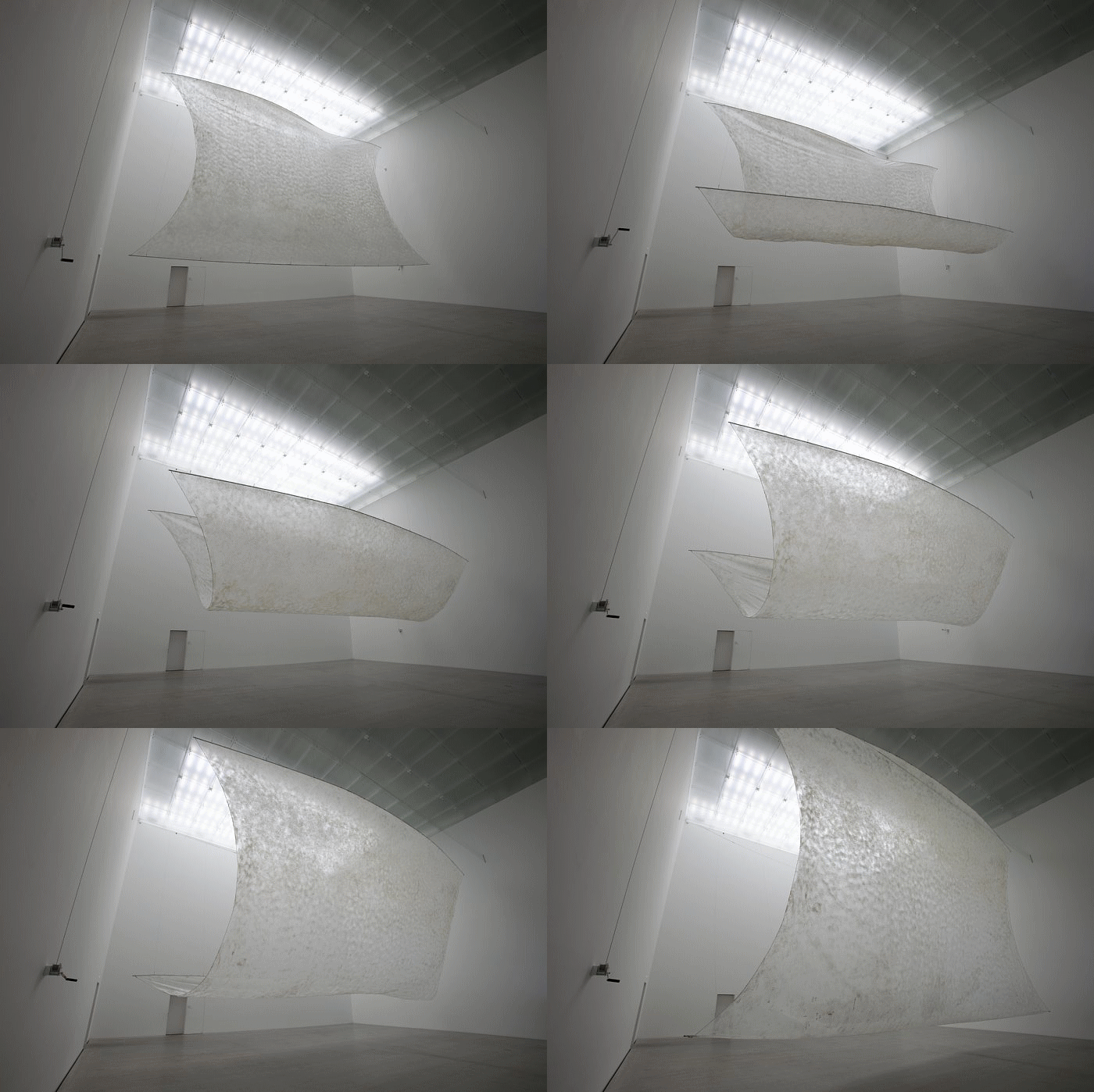
Silk No.4 A, 2011. Installation view, 21st Century Museum of Contemporary Art, Kanazawa.
I Enjoy Arranging My Tools
IROHA: Is there anything you enjoy outside of making work?
KAZUO: My hobby is my work, really. (laughs) I enjoy tending the garden at my studio, arranging my tools, and putting them on display.
Some students visited recently and were more surprised by how neatly the tools were laid out than by the work itself. Every time I go to the United States, I bring back tools — there are shapes you simply don't find in Japan. Line them up on a wall, and they become a picture.

The tools he has collected and uses in his studio.
PROFILE
Kazuo Kadonaga is a contemporary artist born into a family of foresters. Moving through wood, bamboo, paper, and silk, he arrived at large-scale glass installations as his primary medium. In 1990, he presented an exhibition at the Alexandria Museum of Art in Louisiana. Shortly after, he adapted an abandoned stone factory in Ishikawa Prefecture to accommodate glassmaking, while continuing to work with materials such as wood.
His first glass works were shown in Tokyo at Space Kaleid in 2000. Based in Los Angeles, he has exhibited extensively across the United States and Europe since 1985. His work is held in major international collections, including the Museum of Glass, Tacoma; the Rijksmuseum Kröller-Müller in the Netherlands; and the Museo de Arte Moderno in Mexico City. He has received numerous awards, including the Contemporary Glass Triennial Award (Toyama).
written by Naomi Yokoyama / Photography: Lynton Gardiner (Mingei International Museum), Evan Walsh (BLUM, Los Angeles); K2 Studio (21st Century Museum of Contemporary Art, Kanazawa) / Cinematographer: Eiichiro Nakamura / Courtesy of Kazuo Kadonaga