
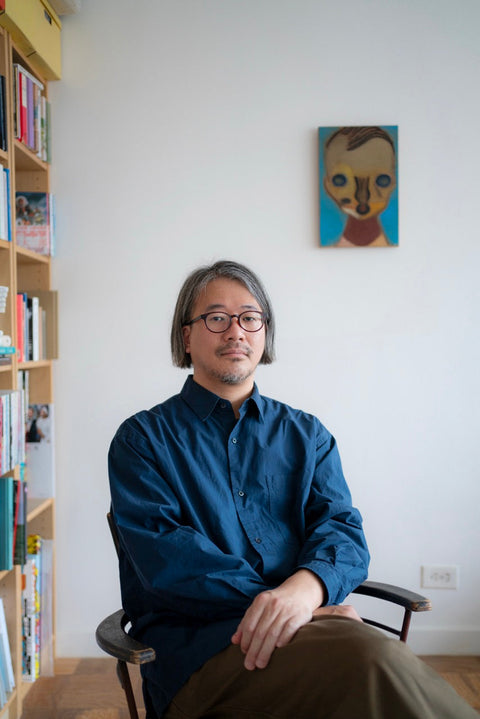
A Builder of Cultural Infrastructure | Kosuke Fujitaka 藤高晃右
Networks in Motion
Kosuke Fujitaka builds the infrastructure that lets Japanese art travel on its own terms. Based in New York, he works at the intersections — between artists and institutions, between Tokyo and the world, between what Japanese culture has to offer and the audiences that haven't yet found it.

Keiichi Tanaami × Fujio Akatsuka, shown at Art on Paper, New York(2023)
Three Fronts: Art Education, Philanthropy, and Manga Abroad
IROHA: What projects are you currently working on?
KOSUKE: There are three main initiatives. The first is a residency program developed in collaboration with Tokyo University of the Arts and NEW INC, the cultural incubator housed within the New Museum in New York. The New Museum just opened a new building, and part of the NEW INC floor will be shared by several universities. Tokyo University of the Arts will establish a base there where young Japanese artists and researchers can work during their stays in New York.
Traditionally, overseas programs were designed to broaden one’s perspective before returning home. Today, what matters more is remaining connected to global networks over time. Participants in this program will work alongside the seventy to eighty emerging artists who are part of NEW INC.

NEW INC (5th floor of the New Museum)
The second project involves supporting fundraising initiatives for Japanese cultural institutions. As the Japan Country Advisor to Myriad USA, I help Japanese museums and universities pursue philanthropic funding in the United States. In April 2025, a briefing at Tokyo University of the Arts brought together about fifty fundraising professionals from national museums and major universities.
The third initiative supports the expansion of Shueisha’s Manga Art Heritage project in the United States. Over the past two years, the project has appeared at art fairs in New York, Los Angeles, and Miami. In September 2025, The Art of Manga at the de Young Museum in San Francisco became the first major museum exhibition in the United States dedicated to manga and recorded the highest opening-day attendance in the museum’s history. The exhibition is expected to tour additional museums across North America.
During the same period in San Francisco, we organized Hirohiko Araki’s JoJo’s Bizarre Adventure and Keiichi Tanaami’s TANAAMI!! AKATSUKA!! at Minnesota Street Project.

Hirohiko Araki’s JoJo’s Bizarre Adventure & Keiichi Tanaami"TANAAMI!! AKATSUKA!!" at Minnesota Street Project in San Francisco
How Japanese Artists Are Going Global — From Relocating to Networking
IROHA: How do you see the Japanese art scene evolving internationally?
KOSUKE: It has clearly been changing. In the early 2000s, Japanese artists seeking international recognition often felt they had to relocate to New York. Today, Japanese artists whose works appear in New York galleries are not necessarily based there. Art fairs in Tokyo and Kyoto attract growing numbers of international visitors, and overseas gallerists often discover Japanese artists there and introduce them to wider audiences.
Every Right Decision Was Once a Risky One
IROHA: What advice would you give to the next generation?
KOSUKE: Looking back, the moments when I chose the riskier path turned out to be the right decisions. Leaving a major corporation to pursue a career in the arts, or leaving Tokyo to move to New York, were never easy choices. But each time I’m grateful I took that step. Japanese society tends to avoid risk, yet risk and possibility are inseparable. If even a small part of you feels drawn to try something new, listen to that instinct and take the first step.

Myriad USA event at Tokyo University of the Arts
What Grapes and a Daughter Have Taught Me
IROHA: What do you enjoy outside of work?
KOSUKE: Two things. One is my child’s music education. My daughter plays both piano and violin, which has made me think about the differences between Japanese and American approaches to education in general. The other is winemaking. We make wine at home using California grapes, beginning by crushing them at a friend’s house and then fermenting and aging them ourselves. There’s something deeply satisfying about creating something with your own hands while following the rhythm of the seasons.
PROFILE
Kosuke Fujitaka is an art business consultant based in New York. Born in Osaka, Kosuke studied at the University of Tokyo, where he also spent time at Baruch College of the City University of New York in 1999 and first encountered the exciting New York art scene in Chelsea, which was just beginning to take off.
After graduating, he joined Sony Ericsson, but his interest in the arts never faded. In 2004, he co-founded Tokyo Art Beat, a bilingual platform introducing Japan's art scene to global audiences, followed by New York Art Beat in 2008. He subsequently joined SmartNews as its first U.S.-based employee, contributing to the company's expansion into the American market.
Now working independently from New York, he advises Japanese cultural institutions, museums, universities, and publishers on international development, fundraising, and global cultural exchange.
written by Naomi Yokoyama / photography: Hidemi Takagi(portrait)
Links