
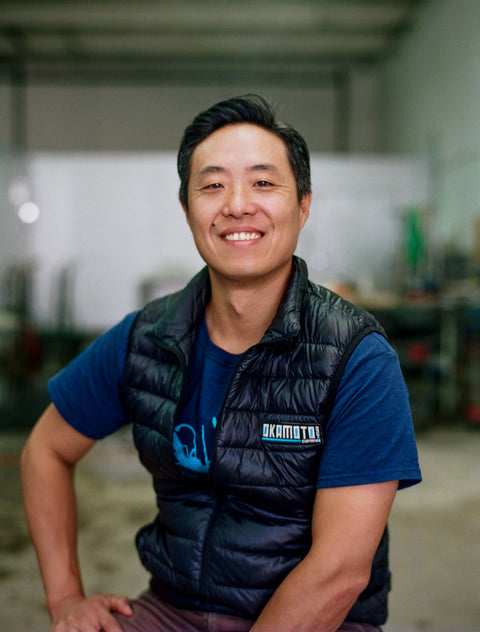
Carving Wonder Out of Ice | Shintaro Okamoto 岡本慎太郎
From a Frozen Lake in Alaska to New York's Biggest Events
From celebrity events and luxury fashion launches to crystal-clear cocktail ice, Shintaro Okamoto has spent decades transforming frozen water into art.
Born in Japan, raised in Alaska, and trained as a fine artist, Shintaro eventually built one of New York’s most respected ice studios.
Along the way, he survived the 2008 financial crisis, helped shape America’s modern cocktail culture.
We visited his studio in Queens and asked him about the unlikely path that led him from a frozen lake in Alaska to some of the world’s most extraordinary events.

Turning blocks of ice into art — Shintaro carving live at Bryant Park.
A Huge Ice Stiletto for The Devil Wears Prada 2
IROHA: Could you tell us about some of the projects you’ve been working on recently?
SHINTARO: We recently created a large ice sculpture for a reception celebrating “The Devil Wears Prada 2”.
It was an interactive ice luge shaped like an oversized stiletto heel inspired by the film’s iconic imagery.
Guests could pour liquor through the sculpture, so it became part installation, part experience.
That’s what makes our work exciting. Every project is different.
We collaborate with top event designers, fashion brands, film studios, restaurants, and private clients, so we constantly get to shift perspectives and challenge ourselves creatively.
We’ve created entire rooms made of ice, celebrity portrait sculptures, full-scale product replicas, even cars carved from ice.
On the other end of the spectrum, we also make cocktail ice with engraved logos for bars and restaurants.
From monumental installations to a single perfect cube, every day brings a new challenge.
We’ve also been fortunate to travel around the world for projects. We’ve worked in places like India, Qatar, Italy, Japan, and recently in Big Sky, Montana, creating sculptures more than 6,500 feet up in the mountains for an après-ski lounge.
 A sneaker-shaped ice sculpture created by Shintaro for Adidas.
Carving Is the Easiest Part
IROHA: Which project has been the most difficult?
SHINTARO: Carving is the easiest part.
The most difficult project is always less about the design or carving and almost always about logistics.
Because ice is a very delicate material. It’s cold, wet, slippery, melting, and constantly changing.
It’s fragile, but it's also extremely heavy and dangerous.
There’s really no room for error. Once we make it, it's one shot. We can't remake it on-site.
One event required more than 100 ice blocks weighing roughly 200 pounds each, installed on a custom structure using lift machines.
We had only one hour between events to complete the installation.
So, the biggest challenge is always coordinating the team, the venue, and the timing.
Installation is always the hardest part.

Shintaro’s work featured in The New York Times.
A Frozen Lake in Alaska
IROHA: You grew up in Alaska because of your father’s work. What was that experience like?
SHINTARO: It shaped everything about who I am.
I was born in Hakata, Fukuoka, and lived there until I was nine years old.
My father had the opportunity to run a Japanese restaurant in Anchorage during the 1980s, so our family moved to Alaska.

Shintaro and his family in Alaska
Before moving, he encountered ice carving while training in Tokyo.
One winter, he took my younger brother and me to a frozen lake, cut a block of ice out with a chainsaw, and carved a swan.
He brought it to a Christmas party, and people loved it. Soon, it became a side business.
At the same time, ice carving in America was beginning to evolve, and my father became part of that pioneering generation.
Creativity was always around me growing up.

Choosing Art Over Medical Science
IROHA: Did you always want to become an artist?
SHINTARO: Very much so. In high school, I became deeply involved in art and even took night classes at a community college.
Eventually, I entered national art competitions and won first place in a major program organized by the National Foundation for Advancement in the Arts.
I was also fascinated by anatomy and medicine and even considered becoming a doctor.
That’s why I chose Brown University.
I wanted both worlds—liberal arts and science—while also studying art through the Rhode Island School of Design.
Eventually, I chose art and later earned my MFA in painting from Columbia University.
Columbia taught me to constantly ask deeper questions:
“Why make this? Why does it matter? “
That way of thinking still guides everything I do today.
I often ask, “Why does this need to be made out of ice?”
I want to design something that's meaningful and relevant to be made out of ice.

A stunning ice dress sculpture showcasing Shintaro’s artistic vision and aesthetic sense.
New York Is a Club
IROHA: How did you start the company?
SHINTARO: After graduate school, I was working as a painter in Brooklyn.
Around that time, my father moved to New York, and we decided to open an ice studio together in 2003.

Shintaro and his father Takeo
The beginning was incredibly difficult.
We had a tiny freezer, one machine, and almost no clients. For the first six months, nothing really happened.
Our first jobs were mostly rescue projects where another ice company had canceled.
A client called us saying, I had an ice sculpture reserved, but my ice company canceled on me. And it's due tomorrow. Can you do it? And we said yes.
It was a snowboarder sculpture with a caviar chiller. And my dad spent all night carving it.
The client loved the sculpture we created, and that client happened to be one of New York’s leading catering companies.
From there, word spread. New York is such a club, like a tight-knit, network. New Yorkers talk. If you do good work, clients recommend you.

A stunning Eiffel Tower sculpted in ice, created for Cipriani.
The Buddha That Changed Everything
IROHA: How did the company grow from there?
SHINTARO: A major turning point came when the Japanese restaurant Megu opened in New York.
I suggested installing an ice sculpture in the center of their dramatic interior space.
The first night we created a samurai armor sculpture. The second night we carved a Buddha.
 Meg’s iconic Buddha ice sculpture that took everyone by storm.
The owners loved it so much that they wanted one every day.
In the end, we created more than 2,000 Buddha sculptures for them.
That project accelerated our growth tremendously.
I hired painter friends to become ice carvers because I realized carving is deeply connected to drawing ability and visual understanding.
Losing 75 Percent of the Business
IROHA: What happened during the financial crisis?
SHINTARO: The Lehman Shock was devastating.
We lost around 75 percent of our revenue almost overnight.
We had to let most of our staff go and seriously question whether the company could survive.
But the crisis forced us to rethink everything. We diversified our clients, restructured the business, and became more flexible.
Around the same time, New York’s cocktail culture was exploding.
People like Jim Meehan and Don Lee began visiting our studio asking about clear ice.
That eventually became the foundation of our cocktail ice business.
It gave us a stable operation that could support the more unpredictable sculpture side of the company.

Iconic Jimmy Choo shoes and bags suspended in ice for a striking presentation.
Work Hard and Be Nice to People
IROHA: What philosophy guides your work?
SHINTARO: I approach ice through both art and entrepreneurship.
I care deeply about creativity, but I also care about creating a meaningful workplace.
Nothing we do happens because of one person.
It takes designers, carvers, delivery teams, installers, office staff—everyone.
There’s a poster in our office that says:
“Work hard and be nice to people.”
That’s probably the simplest way to describe my philosophy. Those values came from my father.
Working with ice also teaches humility.
You can spend countless hours creating something beautiful, and then it disappears.
Ice is ephemeral. That impermanence teaches you to focus on the process rather than ownership or ego.

An incredibly intricate grasshopper sculpted in ice — reminding us that even beauty is temporary.
Interesting Work Matters More Than Fame
IROHA: What advice would you give to young people?
SHINTARO: I think the fundamentals never change.
Work hard and be nice to people.That’s it.
I believe in kindness, collaboration, peace, common sense, and consistency.
I’ve never been particularly interested in fame or reputation.
What matters to me is doing interesting work and surrounding myself with inspiring people.
Over the years, I’ve had the opportunity to work with some of the best designers, chefs, bartenders, and creative minds in the world—not because I chased status, but because I cared deeply about the work itself.
That’s always been the goal.

PROFILE
Shintaro Okamoto is a Japanese-born artist and founder of Okamoto Studio, a New York–based studio internationally recognized for transforming ice into immersive sculpture, installation, and live performance.
Born in Fukuoka and raised in Alaska, Okamoto learned the craft alongside his father, master sculptor Takeo Okamoto, whose achievements include a Silver Medal in ice sculpting at the Nagano Winter Olympics.
During his student years, Shintaro was recognized as a U.S. Presidential Scholar and honored at the White House before earning a BA from Brown University and an MFA from Hunter College. In 2003, father and son co-founded Okamoto Studio in New York City.
Working at the intersection of craftsmanship, design, and contemporary art, Okamoto has spent more than two decades expanding the possibilities of ice beyond traditional sculpture. Today, the studio collaborates with leading brands, cultural institutions, restaurants, fashion labels, and hospitality groups to create large-scale installations, custom cocktail ice programs, and experiential works that exist only for a moment before disappearing.
Through collaborations with HBO, Disney, Versace, Adidas, The North Face, and globally recognized brands and cultural institutions, Okamoto Studio has become known for creating emotionally charged environments that blur the boundaries between contemporary art, live performance, and brand experience. The studio's work has been featured by The New York Times, ABC News, HBO, WIRED, Architectural Digest, and international media outlets.
For Okamoto, ice is both medium and philosophy: physically powerful yet inherently temporary, capable of creating atmosphere, tension, and memory precisely because it disappears.
LINKS