
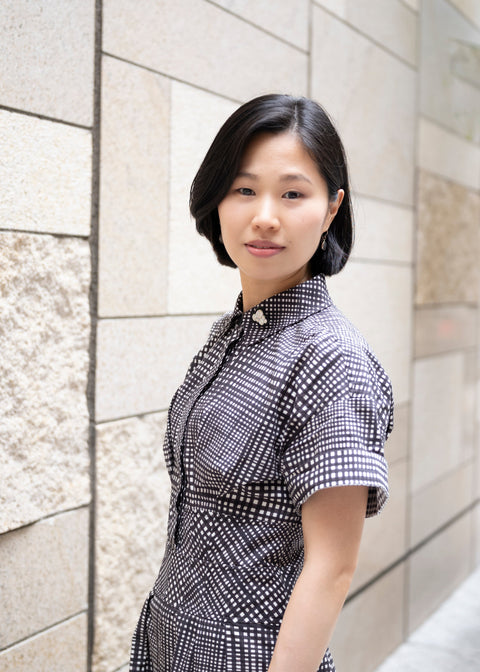
The Gallerist as Translator | SHOKO AONO 青野祥子
Carrying the Spirit of Japanese Kōgei Across Borders
For Shoko Aono, a work of art is not something to be kept at a safe distance.
A tea bowl asks to be lifted and turned in the hand. Lacquer, for all its apparent delicacy, resists heat and water and time. Washi is not fragile decoration but one of the strongest materials ever made by hand. To understand any of them, one has to come close.
Aono studied philosophy in Japan before she came to art, and the questions have not left her. Her question is rarely how an object was made; it is what the object asks of the person standing before it.
Through Ippodo Gallery New York, she has spent nearly two decades placing the work of living Japanese artists directly in the path of a global public—not to explain Japan, but to make an encounter possible.
Her conviction is a simple one, held seriously: that beauty can be shared across any border, and that art remains one of the few things capable of carrying a culture intact from one people to another.

Ippodo gallery in Traibeca Photo: Courtesy of Ippodo
Finding a Calling in Cultural Exchange
IROHA: Your background is in philosophy rather than business. How did you come to open and run a gallery in New York?
SHOKO: I never imagined that I would own a business in New York, or that I would open a gallery anywhere at all.
I studied philosophy in Japan, as an undergraduate and then as a graduate student, and my master's thesis was on Plato and ancient Greek thought. That work grew out of questions I had carried since I was a child: Why am I here? What is a life for? How should a person live? I assumed I would go on asking them the way I had been trained to—through texts, quietly, at a desk.
My first experience of the art world came in 2006, shortly after I completed my master's degree at Sophia University. I organized my mother's gallery's presentation at La Biennale des Éditeurs de la Décoration at the Carrousel du Louvre in Paris, where we introduced Japanese art and handcrafted materials of exceptional quality.
That period changed the direction of my life. I saw people with no particular connection to Japan respond to this work seriously and immediately—not as something exotic, but as something that spoke to them directly. It became clear to me that the work needed to be carried outward, and that carrying it was itself a form of thinking.
I began to understand that my role might not be to pursue philosophy academically, but to enter the world and put things into relation with one another—to stand between Japanese culture and people who had never encountered it.
Art allows us to approach how another person thinks and feels. That, to me, is inseparable from compassion, and compassion is inseparable from what makes us human. Bringing people into contact through that understanding is where I found my purpose.
I stayed in Paris for eight months. I knew almost nothing about business; I learned by doing, and I made many mistakes. In the end I had to return to Japan, because there was a limit to what I could sustain financially.
But the question stayed with me: if I did not build this bridge, who would? I was convinced that if I could truly understand the Japanese sensibility—the awareness of the seasons, the attention to the smallest detail, the discipline of our artisans—and find the right form for it in another language, it would reach people anywhere.

"Light and Abundance: Gold in Japanese" Exhibition in March, 2025
Why New York
IROHA: Why did New York become the place where you wanted to build that bridge?
SHOKO: I spoke with a Japanese chef who had lived and worked in Paris for many years about my wish to bring Japanese culture to people outside Japan. He told me to look at London, or at New York.
In November 2007 I came to New York to see the city for myself. It was a beautiful autumn. What struck me was not its scale but its density of difference—how many origins, languages, and histories were pressed together in one place, and how much energy that produced.
I felt that precisely because New York belongs to no single culture, it was the right place to attempt this. A city where nearly everyone has come from somewhere else is a city prepared to receive something it does not yet know.
I opened the gallery in 2008, at twenty-seven. Since then we have organized around 130 exhibitions and taken part in 30 art fairs. I work with museums, curators, collectors, designers, and scholars, and in every case my aim is the same: to bring them into direct relation with living Japanese artists.

Installation of Jihei Murase at Ippodo gallery
Translating a Cultural Language
IROHA: What is the central challenge of presenting Japanese art to an American audience?
SHOKO: Translation is at the center of what I do, and it has very little to do with moving words from one language into another. What has to be translated is a framework—the assumptions a culture makes so quietly that it never states them aloud.
In Japan, kōgei—usually rendered in English as "craft"—encompasses artistry, technical mastery, and philosophical depth of the highest order.
But in the Western fine-art tradition, "craft" has long been treated as secondary to painting or sculpture. A single word, translated too quickly, can diminish an entire discipline: Japanese ceramics, lacquer, bamboo, metalwork, textiles—centuries of thought concentrated into an object.
Fifteen or sixteen years ago, when I first presented tea bowls here, many people had never considered that a work of art might be lifted, turned in the hand, brought close to the face. In Japanese aesthetics that is not a casual gesture; sensory experience is the point. A work is not only seen. It is known through the hand—its weight, its surface, its temperature, sometimes its scent.
That is why I ask visitors to hold the work. Most galleries would not permit it. I believe that without it, something essential goes unsaid. Japanese art asks for all five senses, and it asks for time.

Installation of Yukiya Izumiya at TEFAF MAASTRICHT 2026
Nature, Material, and Memory
IROHA: What aspects of Japanese culture help people understand these works more deeply?
SHOKO: Japanese art is bound to nature, to the seasons, and to daily life. You can see it in ceramics, in lacquerware, in bamboo baskets, in washi, in shoji screens, in architecture.
Traditional Japanese houses were built of wood and paper. Beside brick or concrete they can appear fragile, but that apparent fragility creates a different relationship to the world outside. You feel the weather. You feel the air change. And because people sit on tatami, the eye is lower and the body is nearer the ground. One lives closer to things.
That way of living shapes what we find beautiful: seasonal food, natural materials, texture, the small movements of light across a day. Those sensibilities are present in the work.
Lacquerware is a good example. It looks delicate and is in fact extraordinarily resilient—resistant to heat, to water, to oil—which is why it has served for centuries as the material of bowls and chopsticks.
Washi is much the same. It appears fragile, yet it is remarkably strong, because its fibers remain long and interwoven rather than cut short as in ordinary wood-pulp paper.
These materials describe the culture that made them: quiet, unassuming, acutely sensitive—and far more enduring than they appear.

Tea Caddy by Terumasa Ikeda Photo: Courtesy of Ippodo gallery
New York as a Mirror
IROHA: Are Japanese artists eager to show their work in New York?
SHOKO: Yes. New York is an international market, but more than that it is a place where an artist meets people whose assumptions are not their own. Work is received differently here than in Japan, and that difference can be productive.
In Japan, when an artist says they are the fourth generation of a lacquer family, the sentence carries its own weight; everyone understands the lineage standing behind it. In the United States, it explains nothing on its own.
People here want to know why. Not how a work was made, but why this particular person makes it—what brought them to this life in the first place. Those questions reach down to the root of a practice, and artists often find something there they had not yet put into words. It can be uncomfortable. It is almost always valuable.
I hope people will meet the work with all five senses. And I have come to believe, more strongly each year, that one of the roles of a gallery is to make visible through art a sense of beauty that can be held in common—across languages, across origins.
Growing With Artists
IROHA: How do you find and choose the artists you represent?
SHOKO: Whenever I am in Japan, I meet artists almost every day. I go to exhibitions, I visit studios, I stand in front of the work, and I talk with the person who made it. There is no substitute for that.
IROHA: Your approach seems to emphasize long-term relationships rather than simply selling objects.
SHOKO: It matters to me more than anything else. I want the gallery and its artists to grow together—to talk, to wait, to learn from one another, to let an idea take the time it needs.
We do not tell an artist what to make, or ask for ten pieces because ten pieces will sell. We move through the work together.
That requires patience, and it requires respecting the pace of making. A lacquer artist may need a year to complete ten or thirteen works. A ceramic artist may need six months, or longer. Some artists are planning two years ahead. These are living people, with their own sensibilities, their own rhythms, their own convictions. A gallerist cannot say, "Ten pieces by this date," and still expect the work to be what it should be.
I think artists feel that care, and it sustains them. A gallery should be more than a place where art is sold. It should be a place where an artist can go further than they have gone before.
I write the essays for every exhibition myself, because I want each artist to have a voice here, particularly those who do not speak English. That writing is one of the parts of this work I love most.

Sculpture installation by Ken Yasuda Photo: Courtesy of Ippodo Gallery
Resilience, Crisis, and Kindness
IROHA: You opened the gallery during a difficult economic period. What sustained you in those early years?
SHOKO: The gallery opened in 2008, the year of economic crisis. At the beginning I was not building anything; I was surviving. Four years later, in 2012, my Chelsea space flooded during Hurricane Sandy, and I had to begin again uptown while also working out where I myself would live.
My mother gave me advice I have never forgotten. She said: do not always go to the most powerful people for help. Often the people who understand hardship are the ones who truly know how to give it.
In those early years there was a man named Louis who worked as a cleaner—windows, gallery floors, long hours, hard work. There were many nights I slept at the gallery because there was no time to go home. Louis noticed. One day he bought carrots, made fresh juice with his own hands, and brought it to me. He said only, "Here's your medicine." He kept giving me his juice and salads; he chopped the lettuce by himself.
That has stayed with me ever since. People who have known what it is to need help are often the readiest to offer it.
New York is full of encounters like that. It is one of the reasons I love this city.
There have been many hard passages—the financial crisis, Hurricane Sandy, then the pandemic. Each one clarified something. After the flood I could not operate the gallery, but I could still present the artists' work at a fair in Chicago and keep those connections alive. During the pandemic we held artist talks online; we could not be in a room together, but the conversations reminded me how much people need to remain in contact with one another.
I have come to think that bringing art into people's lives during difficult times is among the most human things one can do. The harder the passage, the clearer that has become to me.

TEFAF Maastricht 2026
A New Chapter in Tribeca
IROHA: You relocated Ippodo Gallery New York to Tribeca in March 2025. How has the transition been?
SHOKO: Tribeca is home to a great many contemporary art galleries, and there is something meaningful in placing this work in that context—in inviting people to encounter kōgei alongside contemporary art rather than apart from it.
At the same time, artificial intelligence is advancing very quickly. Perhaps for that reason, I find myself valuing more and more what can only come from the human hand: the beauty of Japanese craft, and a sensibility formed over centuries.
I want to remain authentic. Some galleries adapt their program to the American market—adjusting the scale of works, for instance, to suit local preference. I understand why. But I intend to hold to what I believe, and to continue presenting work shaped by the hands and the discipline of Japanese artists, without softening it to make it easier to receive.
Advice for the Next Generation
IROHA: What advice would you give to a young person who wants to work in the art world?
SHOKO: Never give up. It is a simple thing to say, and I believe it completely. If you do not stop, something will happen.
I would also say: choose the difficult path from time to time. There is always a reason to take the easier option, to step back, to stop. But you cannot know in advance where a hard choice will lead, and that not-knowing is where everything of consequence lies.
And in a life full of phones and screens and constant communication, do not lose your five senses. Look. Touch. Smell. Listen. Feel. They are the foundation of creativity, and I believe they are the foundation of being human.
For artists who want to work internationally, one practical thing: learn English. It is difficult when everything must pass through another person. Language gives an artist direct access to the world, and directness matters.
I have deep respect for Japanese artists—for their precision, their sensitivity, their discipline, and their capacity to make work of extraordinary quality. The world moves quickly now, and there is constant pressure to put business and speed first. But taking the time to make something truly good still matters. I would go further: it may matter more now than it ever has.
PROFILE
Shoko Aono is the Principal of Ippodo Gallery New York and a leading advocate for contemporary Japanese Kōgei.
After earning a master's degree in philosophy from Sophia University, she joined Ippodo Gallery Tokyo in 2006, participating in international art and design events, including La Biennale des Éditeurs de la Décoration at the Carrousel du Louvre in Paris.
In 2008, she moved to New York and established Ippodo Gallery New York.
Since then, she has worked with more than 200 Japanese artists, presenting their work in around 130 exhibitions and at 30 art fairs, including TEFAF Maastricht, across the United States and Europe.
Through Ippodo Gallery, Aono continues to bridge Japanese artistic traditions and contemporary global culture, introducing the beauty, craftsmanship, and philosophy of Japanese Kōgei to audiences worldwide.
Links
IPPODO GALLERY 35 N Moore St, New York, NY 10013
written by Eri Kurobe / Photography: Courtesy of Ippodo gallery